Showing posts with label culture. Show all posts
Sunday, May 6, 2012
A Walk Through Hell
We weren't the best because of our record or our reputation or how we finished at different tournaments. We were the best because of how hard we pushed each other and how hard we wanted to work for each other. We were the best because of how we fought for, genuinely cared about, and loved each other.
Wednesday, March 9, 2011
Winning is a Culture, Vol. V: Ownership
Volume V was supposed to be "Playing to a Standard", but since I was taking eight years on that one and inspiration struck sooner than I could get that posted, I've bumped it down to Vol. VI.
A few different things inspired this post about ownership. First was Robyn Fennig's post about "beasting everything". Another was (because you knew they'd be in here somehow) me thinking about what a great job the UConn women are doing with such a young, inexperienced team.
Let's start with that last thought. This season UConn is no longer the powerhouse that it has been the last few years. While still among the favorites to win the National Championship, they are no longer the overwhelming favorite they once were. Without bringing graduated players into the conversation, the idea of starting a season with FIVE freshmen on a roster of only 11 players is pretty daunting. Then take away your returning starting point guard, your team's quarterback, lost for the season with a torn ACL. Drops you down to ten eligible players, half returners and half rookies. You bring back two starters and two reserves who got limited playing time last season. In the middle of the season, you lose another player to transfer. Nine eligible players. One freshman has just come off consecutive knee surgeries and doesn't have her legs back yet, while another just isn't ready for major minutes. So you have a steady rotation of seven players. And just about two weeks ago, it was announced that Heather Buck, the only backup post UConn regularly plays, will be out a few weeks, and possibly the rest of the season, with a stress fracture. Eight players dressed and a steady rotation of six.
I support my team to the end, but I have to admit -- prospects seemed dubious. I was nervous about how UConn would make it through the post-season with such a short and inexperienced bench. Even with the best player in the country in Maya Magnificent Moore, foul troubles or an off-shooting night can take players out of the equation with a swiftness. Never mind the post-season, how would the Huskies make it through Big East play unscathed? Geno said he'd be surprised if the team didn't lose a Big East game this season. But since that loss to Stanford back in December, UConn's ripped off twenty straight wins, with half of those games coming against teams ranked in the Top 25 (five games against teams in the Top 10). They ran the table in the Big East, and won the regular season championship. During the Big East tournament, they played 3 games in 3 days, with two blowouts in quarters (Georgetown, 59-43) and semis (Rutgers, 75-51) and a much closer championship game (Notre Dame, 73-64). They won their 17th Big East tournament title last night.
The road "post-Stanford" certainly wasn't easy. The Big East is one of the toughest -- if not the toughest -- conferences in the country. UConn also played three out-of-conference games against then-#3 (and then undefeated) Duke (87-51), then-#10 North Carolina (83-57), and then-#12 Oklahoma (86-45). When tournament play started, as mentioned, they played three grueling games (the games were more physical than the scores may let on) with a short bench in three consecutive days.
So how does that happen, when the odds are seemingly stacked against you, as I've so tediously and superfluously detailed?
Of course, the quality and talent of your players helps. Maya Moore is the best player in the country. Simple. (Although even she is human, as evidenced by an anemic shooting night against G-Town, 2-12 for 6 points.) Having a stellar coaching staff helps too -- coaches that can keep players focused and can help prepare players for the rigors of the college season.
To me, the missing third heat is ownership -- that is, a player's ownership of the team's success and a player's ownership over their own effort. Especially on a young team, "ownership" can be crucial to how soon a player "gets it". Bringing young players into an established program isn't easy. They'll either do things just because they're told to do them, without understanding them or truly appreciating them, or they'll question everything that's asked of them and everything they're doing. I'm not saying there's no room for change or new ideas in winning programs, I'm just saying that there's a reason why good teams are always good, and there's a reason why they do things the way they do -- there's a method to the madness.
A player takes ownership when they buy into the program, when they understand why they do what they do, and when they put the work in to do it. With a team whose history is as illustrious and Charlie Sheen-approved winning as UConn, it's easy to fall back on tradition and old names, and it's easy to hang your head when you don't live up to them. "I'll never be the next Diana Taurasi/Sue Bird/Tina Charles/Rebecca Lobo, etc. etc." It's harder to say, "Nah. I'm gonna do me."
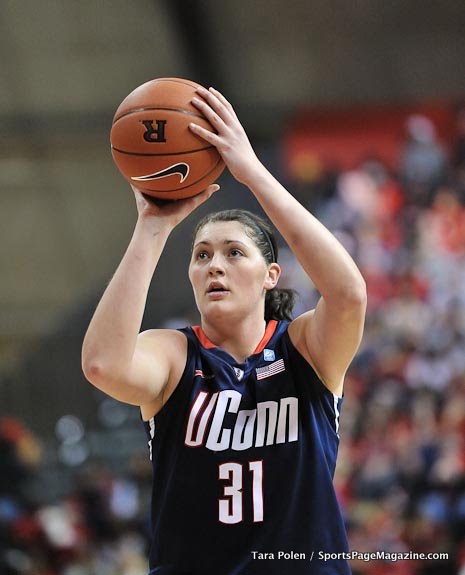
The player who I believe best epitomizes the concept of "ownership" on the UConn team is freshman center Stefanie Dolson.
(Wow. I'm really cussing long-winded. It took me that long to spit that out, when I could have just told you up front that I thought Stef's a champ. Welp, if you've read this far, sorry 'bout it.)
I remember Stef Dolson's second collegiate game, against 6'8 Brittney Griner's #2 Baylor on ESPN2. Rough imagining that as your second collegiate game, huh? She looked nervous and pale as a ghost prior to tipoff, and she was a mess for basically all of the game. She'd get a tough rebound and show flashes of talent, but then she'd turn around and miss a point blank, wide open layup or she'd travel or throw it away. She scored 2 points on 1-6 shooting with 2 turns, and she played twelve minutes total. She fouled out of the game with 7:24 left in the second half. You couldn't really blame her for her poor performance, but it was hardly an effort you'd want to hang your hat on.
At the start of the season, we heard about Stef getting benched or pissing Geno off because she wasn't working as hard as she could at practice or she didn't have the right attitude. She got called out by her teammates and the coaches for not rebounding more, despite being the tallest player on the team. The name "Tina Charles" kept coming up, and you'd start feeling sorry for the kid (and it didn't really help that she picked the familiar #31).
But instead of hanging her head and saying, "Aww shucks, I'll never fill Tina's shoes" and feeling sorry for herself for the rest of the season, Stef went to work. Unforch, I am a cheap doucher and refuse to pay for a HoopStreams subscription, so I only get the UConn games that air on national television, which is to say that I don't get to watch a whole lot of games through the course of the season. But almost every single time I've watched them play, Stef has gotten better by leaps and bounds, whether she's impressing me with her 15-foot jumper or icing free throws on the road against Notre Dame in a squeaker or blocking shots/picking pockets or running the floor or showing some nice post moves ... I can go on and on. The kid looks better and smoother on both ends of the court every time I watch her play.
The story goes that after UConn's loss at Stanford, Chris Dailey threw down a challenge for Stef -- told her that she needed to up her game, and it started with conditioning, endurance, and weight training. So Stef got to work. She has a few extra conditioning practices a week in addition to her normal practices, and during normal practices, she runs more than the other players. I've read that on rebounds off misses, other players will take off down the court immediately while Stef has to run to the foul line, and then from the foul line to the baseline before running down the court to catch up with the action. I love that quote from Stef at the end, about finally realizing that she couldn't fill TC's shoes, and that she had to start making a name for herself. It was like she realized, "Hey. This team needs me to contribute, and they need me to be at my best for the team to be at its best."
The work that she's been putting in is extremely impressive and completely evident in her game now. Her conditioning has changed so much, and you can just tell that she's running so hard all game long, even if she's not "running fast". I remember in the first couple of games or so she played 15-20 minutes, usually not more than that, and she always looked gassed or ready to give up. Now, she's playing 30+ at a high level. It's incredible. She looks like a completely different player in all facets of her game. I used to get nervous when they'd throw the ball down to her in the low post, afraid that she'd either miss a layup or travel with the ball. But now Stef has got the turnaround hook over either shoulder, nice footwork to get around/under players, and a really great eye/passing touch. She's got the nice soft J from 15, and I've even seen her handling the ball a little bit, too! I remember when 6'5 Stef was getting out-rebounded by 5'11 Kelly. She gets after those boards now! She doesn't give up on balls, and when she gets offensive boards she can go up strong with them. Even when she doesn't get the ball she looks good. She's constantly working in the post, always moving, always working to get position. Notre Dame's bigs could not keep her out of the post last night. On one possession, I even heard her calling for the ball on TV. She's totally owning it right now. On defense at the beginning of the year, it was like she couldn't even look at a player without picking up a foul. But now she's moving her feet better, blocking shots, picking pockets, not letting her girl get in position, and most importantly -- not fouling.
Her transformation was physical and seemingly mental, too. The Stefanie Dolson I saw in the first few games was nervous and tentative. She looked like a walking turnover. (But not like the "Dang it, you turned it over again!" kind of walking turnover. More of a "Oh, bless your heart!" kind of walking turnover.) The Stefanie Dolson I see now is a beast. Legit. Calling for the ball. Straight up dominating the post. Confident. Fired up. Not afraid to swing some elbows when other teams try to hack her after a rebound. It's been amazing to watch.
The past three games really sold me on Stefanie Dolson. (I've decided I have to stop declaring "favorite players" on UConn. Every time I declare one, I get a new one about a day later. So they're all my favorites. Every last one of 'em.) She scored 60 points and grabbed 26 boards over the course of 3 games -- 24 and 8 against Georgetown, 12 and 9 against Rutgers, and 24 and 9 against Notre Dame. She played all forty minutes in the championship game against Notre Dame and never gave up, no matter how tired she must have been. She was named to the All-Tournament team, and should have been named Most Outstanding Player, too. It's been amazing what UConn has been able to do this season, and it really couldn't have been possible without the contributions of players like Stefanie Dolson. Pretty far cry from that hot mess we saw on TV back in October (or whenever that Baylor game was, hell if I remember).
Go on with your bad self, girl.

Phew.
Okay, if you lived through my UConn/Stef Dolson gush-fest (at this point it has become abundantly clear to you that I really only used this post as a guise to j my p's over how awesome UConn is and you feel cheated, like you've been taken on a farcical ride, and of course all I have to say is you should have known better, and sorry I'm not sorry), then you can see me try to feebly relate it to the building of a winning program.
It's hard to bring new, young players into a program, especially so when there's a big age difference in the group or when the numbers aren't generally pretty even (i.e. even numbers of players in each class). Like I said, young bucks either go through the motions without understanding what they're doing and why they're doing it, or they want to question everything. But doing something halfheartedly almost doesn't count as doing it at all -- if you're gonna show up to play with only half of you, you and your team are probably better off if you just didn't show up at all. A player reaches their full potential only when they take ownership of their efforts, and when they realize that they have something to contribute to the team's success.
While I don't entirely think the concept of "playing for someone", for example playing well to get a group of seniors out on top (i.e. UConn with Maya and Lorin), is stupid, I prefer the concept of playing to the best of your ability for the good of the team goals. After all, how's that saying go? You're only as strong as your weakest link? The whole is only at its best when its individual parts are at their best, bringing in the idea of "beasting everything". It's obvious that Stef has been beasting practice. She's been beasting her conditioning. She's been beasting the weight room. All of that work and all of that beasting has found its way to her game on the court, and all that has translated to team success.
I had a lot of great leaders to look up to during my time at Illinois. One (hilarious) example that stands out to me is my buddy Murrles Kim. We had such a stud senior class that year. Even if Mary had decided to play it safe and not attempt to come back from her ACL tear as early as she did, we still would have had plenty of talent in the stables. But instead of saying, "Aww, it's okay, we have a bunch of ballers who will step up and show out, they don't need me", Mary worked hard to get back into playing shape. She still came to all our practices and tournaments even though she wasn't able to play. She took ownership of her contributions -- she never sat on her can back at her apartment getting drunk and watching trashy television (not during practice time anyway, ZING!) and she never sat on the sidelines watching us work at practice, she worked too. She took ownership of her role on the team and came back to help anchor our handling core with Felly Foster for Nationals. It was inspiring, and it was awesome to have our teammate back on the field with us.
I don't know if I can stress how important each individual is to a team, from the starters all the way to the Rudy walk-ons. Your work may not show up in the box score, but it manifests itself on the field and court all the time. Records may not show that you made your team's star cutter work for his/her catches at practice last week, but it shows when he/she is tireless and relentless in their cutting on the field. It's so important that each individual give it their everything and their best all the time because it really, truly does translate to team success. Not every single player on your team can win a tournament MVP title, but everybody on your team gets a ring when you win a National Championship.
And y'know, while I'm at it, an attitude I've always found to be completely asinine is the "We'll be good in X years/seasons" attitude. This isn't grade school anymore. You don't get "better" at basketball just because you grow a couple inches from one summer to the other. It's not about the passage of time, it's about the work you do during that duration. It's true, you may well be a good team in a season or two (case in point: the Illinois women's basketball team), but you "get good" by working. It's an oft heard phrase in college athletics that you see the biggest jump in improvement between a player's freshman and sophomore years, and it's because they've learned what's expected of them, not because they simply grew one year older. They've learned what they need to do, what they need do better, and how to properly prepare and train. And you don't get good just because you just get older -- that's not what they mean by "experience". "Experience" means that you've learned something and you've worked at it.
Take ownership of your development. Take ownership of your work and your contributions to the team. Take ownership of your team, and recognize that you have a stake in your team's failures and successes. The team can only be at its best when every individual player is at its best. Winning programs continue to win because its players understand the roles they play and the work they must put in.
-----------------------------------------------------------------
If you'd like to read more about what I believe creates a culture of winning, click on the label "culture" for the "Winning is a Culture" series.
A few different things inspired this post about ownership. First was Robyn Fennig's post about "beasting everything". Another was (because you knew they'd be in here somehow) me thinking about what a great job the UConn women are doing with such a young, inexperienced team.
Let's start with that last thought. This season UConn is no longer the powerhouse that it has been the last few years. While still among the favorites to win the National Championship, they are no longer the overwhelming favorite they once were. Without bringing graduated players into the conversation, the idea of starting a season with FIVE freshmen on a roster of only 11 players is pretty daunting. Then take away your returning starting point guard, your team's quarterback, lost for the season with a torn ACL. Drops you down to ten eligible players, half returners and half rookies. You bring back two starters and two reserves who got limited playing time last season. In the middle of the season, you lose another player to transfer. Nine eligible players. One freshman has just come off consecutive knee surgeries and doesn't have her legs back yet, while another just isn't ready for major minutes. So you have a steady rotation of seven players. And just about two weeks ago, it was announced that Heather Buck, the only backup post UConn regularly plays, will be out a few weeks, and possibly the rest of the season, with a stress fracture. Eight players dressed and a steady rotation of six.
I support my team to the end, but I have to admit -- prospects seemed dubious. I was nervous about how UConn would make it through the post-season with such a short and inexperienced bench. Even with the best player in the country in Maya Magnificent Moore, foul troubles or an off-shooting night can take players out of the equation with a swiftness. Never mind the post-season, how would the Huskies make it through Big East play unscathed? Geno said he'd be surprised if the team didn't lose a Big East game this season. But since that loss to Stanford back in December, UConn's ripped off twenty straight wins, with half of those games coming against teams ranked in the Top 25 (five games against teams in the Top 10). They ran the table in the Big East, and won the regular season championship. During the Big East tournament, they played 3 games in 3 days, with two blowouts in quarters (Georgetown, 59-43) and semis (Rutgers, 75-51) and a much closer championship game (Notre Dame, 73-64). They won their 17th Big East tournament title last night.
The road "post-Stanford" certainly wasn't easy. The Big East is one of the toughest -- if not the toughest -- conferences in the country. UConn also played three out-of-conference games against then-#3 (and then undefeated) Duke (87-51), then-#10 North Carolina (83-57), and then-#12 Oklahoma (86-45). When tournament play started, as mentioned, they played three grueling games (the games were more physical than the scores may let on) with a short bench in three consecutive days.
So how does that happen, when the odds are seemingly stacked against you, as I've so tediously and superfluously detailed?
Of course, the quality and talent of your players helps. Maya Moore is the best player in the country. Simple. (Although even she is human, as evidenced by an anemic shooting night against G-Town, 2-12 for 6 points.) Having a stellar coaching staff helps too -- coaches that can keep players focused and can help prepare players for the rigors of the college season.
To me, the missing third heat is ownership -- that is, a player's ownership of the team's success and a player's ownership over their own effort. Especially on a young team, "ownership" can be crucial to how soon a player "gets it". Bringing young players into an established program isn't easy. They'll either do things just because they're told to do them, without understanding them or truly appreciating them, or they'll question everything that's asked of them and everything they're doing. I'm not saying there's no room for change or new ideas in winning programs, I'm just saying that there's a reason why good teams are always good, and there's a reason why they do things the way they do -- there's a method to the madness.
A player takes ownership when they buy into the program, when they understand why they do what they do, and when they put the work in to do it. With a team whose history is as illustrious and Charlie Sheen-approved winning as UConn, it's easy to fall back on tradition and old names, and it's easy to hang your head when you don't live up to them. "I'll never be the next Diana Taurasi/Sue Bird/Tina Charles/Rebecca Lobo, etc. etc." It's harder to say, "Nah. I'm gonna do me."
The player who I believe best epitomizes the concept of "ownership" on the UConn team is freshman center Stefanie Dolson.
(Wow. I'm really cussing long-winded. It took me that long to spit that out, when I could have just told you up front that I thought Stef's a champ. Welp, if you've read this far, sorry 'bout it.)
I remember Stef Dolson's second collegiate game, against 6'8 Brittney Griner's #2 Baylor on ESPN2. Rough imagining that as your second collegiate game, huh? She looked nervous and pale as a ghost prior to tipoff, and she was a mess for basically all of the game. She'd get a tough rebound and show flashes of talent, but then she'd turn around and miss a point blank, wide open layup or she'd travel or throw it away. She scored 2 points on 1-6 shooting with 2 turns, and she played twelve minutes total. She fouled out of the game with 7:24 left in the second half. You couldn't really blame her for her poor performance, but it was hardly an effort you'd want to hang your hat on.
At the start of the season, we heard about Stef getting benched or pissing Geno off because she wasn't working as hard as she could at practice or she didn't have the right attitude. She got called out by her teammates and the coaches for not rebounding more, despite being the tallest player on the team. The name "Tina Charles" kept coming up, and you'd start feeling sorry for the kid (and it didn't really help that she picked the familiar #31).
But instead of hanging her head and saying, "Aww shucks, I'll never fill Tina's shoes" and feeling sorry for herself for the rest of the season, Stef went to work. Unforch, I am a cheap doucher and refuse to pay for a HoopStreams subscription, so I only get the UConn games that air on national television, which is to say that I don't get to watch a whole lot of games through the course of the season. But almost every single time I've watched them play, Stef has gotten better by leaps and bounds, whether she's impressing me with her 15-foot jumper or icing free throws on the road against Notre Dame in a squeaker or blocking shots/picking pockets or running the floor or showing some nice post moves ... I can go on and on. The kid looks better and smoother on both ends of the court every time I watch her play.
The story goes that after UConn's loss at Stanford, Chris Dailey threw down a challenge for Stef -- told her that she needed to up her game, and it started with conditioning, endurance, and weight training. So Stef got to work. She has a few extra conditioning practices a week in addition to her normal practices, and during normal practices, she runs more than the other players. I've read that on rebounds off misses, other players will take off down the court immediately while Stef has to run to the foul line, and then from the foul line to the baseline before running down the court to catch up with the action. I love that quote from Stef at the end, about finally realizing that she couldn't fill TC's shoes, and that she had to start making a name for herself. It was like she realized, "Hey. This team needs me to contribute, and they need me to be at my best for the team to be at its best."
The work that she's been putting in is extremely impressive and completely evident in her game now. Her conditioning has changed so much, and you can just tell that she's running so hard all game long, even if she's not "running fast". I remember in the first couple of games or so she played 15-20 minutes, usually not more than that, and she always looked gassed or ready to give up. Now, she's playing 30+ at a high level. It's incredible. She looks like a completely different player in all facets of her game. I used to get nervous when they'd throw the ball down to her in the low post, afraid that she'd either miss a layup or travel with the ball. But now Stef has got the turnaround hook over either shoulder, nice footwork to get around/under players, and a really great eye/passing touch. She's got the nice soft J from 15, and I've even seen her handling the ball a little bit, too! I remember when 6'5 Stef was getting out-rebounded by 5'11 Kelly. She gets after those boards now! She doesn't give up on balls, and when she gets offensive boards she can go up strong with them. Even when she doesn't get the ball she looks good. She's constantly working in the post, always moving, always working to get position. Notre Dame's bigs could not keep her out of the post last night. On one possession, I even heard her calling for the ball on TV. She's totally owning it right now. On defense at the beginning of the year, it was like she couldn't even look at a player without picking up a foul. But now she's moving her feet better, blocking shots, picking pockets, not letting her girl get in position, and most importantly -- not fouling.
Her transformation was physical and seemingly mental, too. The Stefanie Dolson I saw in the first few games was nervous and tentative. She looked like a walking turnover. (But not like the "Dang it, you turned it over again!" kind of walking turnover. More of a "Oh, bless your heart!" kind of walking turnover.) The Stefanie Dolson I see now is a beast. Legit. Calling for the ball. Straight up dominating the post. Confident. Fired up. Not afraid to swing some elbows when other teams try to hack her after a rebound. It's been amazing to watch.
The past three games really sold me on Stefanie Dolson. (I've decided I have to stop declaring "favorite players" on UConn. Every time I declare one, I get a new one about a day later. So they're all my favorites. Every last one of 'em.) She scored 60 points and grabbed 26 boards over the course of 3 games -- 24 and 8 against Georgetown, 12 and 9 against Rutgers, and 24 and 9 against Notre Dame. She played all forty minutes in the championship game against Notre Dame and never gave up, no matter how tired she must have been. She was named to the All-Tournament team, and should have been named Most Outstanding Player, too. It's been amazing what UConn has been able to do this season, and it really couldn't have been possible without the contributions of players like Stefanie Dolson. Pretty far cry from that hot mess we saw on TV back in October (or whenever that Baylor game was, hell if I remember).
Go on with your bad self, girl.
Phew.
Okay, if you lived through my UConn/Stef Dolson gush-fest (at this point it has become abundantly clear to you that I really only used this post as a guise to j my p's over how awesome UConn is and you feel cheated, like you've been taken on a farcical ride, and of course all I have to say is you should have known better, and sorry I'm not sorry), then you can see me try to feebly relate it to the building of a winning program.
It's hard to bring new, young players into a program, especially so when there's a big age difference in the group or when the numbers aren't generally pretty even (i.e. even numbers of players in each class). Like I said, young bucks either go through the motions without understanding what they're doing and why they're doing it, or they want to question everything. But doing something halfheartedly almost doesn't count as doing it at all -- if you're gonna show up to play with only half of you, you and your team are probably better off if you just didn't show up at all. A player reaches their full potential only when they take ownership of their efforts, and when they realize that they have something to contribute to the team's success.
While I don't entirely think the concept of "playing for someone", for example playing well to get a group of seniors out on top (i.e. UConn with Maya and Lorin), is stupid, I prefer the concept of playing to the best of your ability for the good of the team goals. After all, how's that saying go? You're only as strong as your weakest link? The whole is only at its best when its individual parts are at their best, bringing in the idea of "beasting everything". It's obvious that Stef has been beasting practice. She's been beasting her conditioning. She's been beasting the weight room. All of that work and all of that beasting has found its way to her game on the court, and all that has translated to team success.
I had a lot of great leaders to look up to during my time at Illinois. One (hilarious) example that stands out to me is my buddy Murrles Kim. We had such a stud senior class that year. Even if Mary had decided to play it safe and not attempt to come back from her ACL tear as early as she did, we still would have had plenty of talent in the stables. But instead of saying, "Aww, it's okay, we have a bunch of ballers who will step up and show out, they don't need me", Mary worked hard to get back into playing shape. She still came to all our practices and tournaments even though she wasn't able to play. She took ownership of her contributions -- she never sat on her can back at her apartment getting drunk and watching trashy television (not during practice time anyway, ZING!) and she never sat on the sidelines watching us work at practice, she worked too. She took ownership of her role on the team and came back to help anchor our handling core with Felly Foster for Nationals. It was inspiring, and it was awesome to have our teammate back on the field with us.
I don't know if I can stress how important each individual is to a team, from the starters all the way to the Rudy walk-ons. Your work may not show up in the box score, but it manifests itself on the field and court all the time. Records may not show that you made your team's star cutter work for his/her catches at practice last week, but it shows when he/she is tireless and relentless in their cutting on the field. It's so important that each individual give it their everything and their best all the time because it really, truly does translate to team success. Not every single player on your team can win a tournament MVP title, but everybody on your team gets a ring when you win a National Championship.
And y'know, while I'm at it, an attitude I've always found to be completely asinine is the "We'll be good in X years/seasons" attitude. This isn't grade school anymore. You don't get "better" at basketball just because you grow a couple inches from one summer to the other. It's not about the passage of time, it's about the work you do during that duration. It's true, you may well be a good team in a season or two (case in point: the Illinois women's basketball team), but you "get good" by working. It's an oft heard phrase in college athletics that you see the biggest jump in improvement between a player's freshman and sophomore years, and it's because they've learned what's expected of them, not because they simply grew one year older. They've learned what they need to do, what they need do better, and how to properly prepare and train. And you don't get good just because you just get older -- that's not what they mean by "experience". "Experience" means that you've learned something and you've worked at it.
Take ownership of your development. Take ownership of your work and your contributions to the team. Take ownership of your team, and recognize that you have a stake in your team's failures and successes. The team can only be at its best when every individual player is at its best. Winning programs continue to win because its players understand the roles they play and the work they must put in.
-----------------------------------------------------------------
If you'd like to read more about what I believe creates a culture of winning, click on the label "culture" for the "Winning is a Culture" series.
Tuesday, February 15, 2011
Winning is a Culture, Vol. IV: Building Core Values
As I promised in "Championship Mentality" (... about two, and not eight, months ago, so my thoughts are now a little harder to retrieve in the old mental archives, yikes), I'm revisiting an article published this past December in the Daily Illini about the Fighting Illini volleyball team and their team-building efforts. The article talks about how the team sits down once a week every spring to talk about their team's "core values", the values their team will use to guide their efforts. Some of the examples given in the article are trust, love, and health.
I like the idea of using core values to build a team and using those values to guide the team. They're principles or standards that every team member can go back to when training gets hard or when they've hit a low point in their season, and even when they're not going through rough times. They're lessons that the coaching staff can also apply to the players off the playing field, which is another very important area of development. For example, values like "integrity", "perseverance", and "commitment" can be very important for teams and players. "Integrity" is about playing the game fairly, about competing without cheating. "Perseverance" is about pushing through when it's hard, about sticking with something and working through it until you conquer it -- it's about not giving up. A big one for me is "commitment" -- it's about making sure that every single one of your teammates is willing to make the commitment to the team, to your values, and to winning. That means everyone has promised to give everything they've got all the time. Your team goes nowhere if 7/10 people have made that commitment to giving 100%, and the other 3/10 will give what they can when they decide they want to give it.
A quote that I particularly enjoyed from the article was from Coach Hambly: "I'd rather never win it than not do it the right way."
That's the message you want to send to your kids -- it's about competing and winning with integrity. If you're going to sacrifice your integrity and your morals and your core values to win, then you're on the wrong team. It's about doing things the right way every single time, and being true to yourself and your team. It's HUGE coming from a coach, whose career depends on wins, to say that there's only one way they want to compete and only one way they want to win -- the right way.
Kevin Hambly said it way better than I did in a huge, long, rambling post: "Hopefully they started a championship mentality that led to sustained success over time."
Having a foundation built upon core values (borne of team consensus) is crucial to building winning programs.
As I'm sure is true for many of you reading, ultimate played a big part in my college experience. When I think of college, I'll always inevitably think of college ultimate and my team. There are a lot of regrets that come to mind when I think of my college ultimate career (that I may write about later but probably not because that is sour grapes, grumpy guss, saddles mcgee material that you should only be subjected to if we're both drunk and I've cornered you on Fourth & Daniel or if I'm crying into your lap/chest at Firehaus), but more than anything I'm proud of what we did as a team through my four years. Unsurprisingly, one of my best memories of college will always be qualifying for Nationals in 2009.
What makes me proud of that accomplishment isn't the accomplishment itself, great as it was. What makes me proud is everything leading up to the accomplishment and everything that we did to get there. As a team, we made a commitment to our goals and to each other that we'd work hard and bust our asses no matter what. We decided that we'd call each other out when we needed to, but we'd also be there for each other, always. We decided that "pretty good" wasn't good enough, and that the only people who could decide what happened with our season was us. We decided that we were all in.
What follows after you decide that you're all in is personal. I can type myself silly trying to recreate that experience for you in prose, but those of you who have been there, those of you who have been through it -- you know what I'm talking about, and you know that it's hard to communicate that experience to people who didn't go through it with you, and especially so with those who haven't gone through it at all. It's an unspoken understanding. Through every triumph, every collapse, every moment when you want to give up, every moment when you think you have it all -- what rings true to you and what you remember are your teammates, your team, and your team's values and goals.
I'm probably butchering the phrase, but the journey is the reward. Outcomes, destinations... those are great, but what I'll always, always remember in a deep way is the journey. I'll remember the expectations and the setbacks, the "hey, maybe we have something here..." and the "back to the drawing board" moments. I'll remember the personal pain, and I'll remember feeling pain for my teammates as well. I'll remember the intimacy of it all, how close I felt to everyone, and how many of those people will always be a part of my life. I'll remember the anticipation, the magic electricity, and the dreaming. But more than anything I'll remember the way we worked. I'll remember how it felt to realize that I accomplished something big, something I've dreamed about, and I accomplished it not by chance, not by luck, and not by handout -- by work, by commitment, and by perseverance. Those values and those standards that have become so ingrained in me have come to define my college ultimate experience and the team I love and remember.
So as you can imagine, graduating from college and my college team was admittedly a difficult experience for me. Even though I was facing a new life without a job and the prospect of living at home, for some reason, the scarier thing seemed to be leaving my team. My great fear became "not recognizing" the team that had become such an integral part of my life and my identity. Luckily, a friend reminded me that change isn't always necessarily a bad thing. Inevitably, programs change. You can't stay there forever, and you can't stop new players from coming in. There will always be new faces, new ideas, and new ambitions -- what you hope is that the foundation: your program's culture -- remains.
So figure out what's important to you and your team. Figure out how you want your team to work, how you want your team to carry themselves, and how you want your team to play. Figure out what values are important to you, what kind of program you're trying to build, what type of people you want in your program, and what you want your program to stand for or represent. As time and personnel start to turn over, revisit the things you've discussed and make sure that it's all still relevant to your team, and see if there are any new goals, values, or ideas that need to be added. It might seem silly to think about all these big, macro-level things, but when your players and staff aren't all on the same page, when you don't all believe in and work for the same things, then your program suffers and it's that much harder to win.
They say that great programs are "generational" -- that is, one great program begets another begets another, begets another, and so on so forth. Players and coaches come and go, but as long as the core values and culture of the team remains intact, then the teams continue to be great. As my dude Geno said, if you play the same way, carry yourself the same way, and expect the same things as the players before you, then regardless of the fact that the personnel will change, the team will manage to always stay the same.
------------------------------------
If you'd like to read more about what I believe creates a culture of winning, click on the label "culture" for the "Winning is a Culture" series.
I like the idea of using core values to build a team and using those values to guide the team. They're principles or standards that every team member can go back to when training gets hard or when they've hit a low point in their season, and even when they're not going through rough times. They're lessons that the coaching staff can also apply to the players off the playing field, which is another very important area of development. For example, values like "integrity", "perseverance", and "commitment" can be very important for teams and players. "Integrity" is about playing the game fairly, about competing without cheating. "Perseverance" is about pushing through when it's hard, about sticking with something and working through it until you conquer it -- it's about not giving up. A big one for me is "commitment" -- it's about making sure that every single one of your teammates is willing to make the commitment to the team, to your values, and to winning. That means everyone has promised to give everything they've got all the time. Your team goes nowhere if 7/10 people have made that commitment to giving 100%, and the other 3/10 will give what they can when they decide they want to give it.
A quote that I particularly enjoyed from the article was from Coach Hambly: "I'd rather never win it than not do it the right way."
That's the message you want to send to your kids -- it's about competing and winning with integrity. If you're going to sacrifice your integrity and your morals and your core values to win, then you're on the wrong team. It's about doing things the right way every single time, and being true to yourself and your team. It's HUGE coming from a coach, whose career depends on wins, to say that there's only one way they want to compete and only one way they want to win -- the right way.
Kevin Hambly said it way better than I did in a huge, long, rambling post: "Hopefully they started a championship mentality that led to sustained success over time."
Having a foundation built upon core values (borne of team consensus) is crucial to building winning programs.
As I'm sure is true for many of you reading, ultimate played a big part in my college experience. When I think of college, I'll always inevitably think of college ultimate and my team. There are a lot of regrets that come to mind when I think of my college ultimate career (that I may write about later but probably not because that is sour grapes, grumpy guss, saddles mcgee material that you should only be subjected to if we're both drunk and I've cornered you on Fourth & Daniel or if I'm crying into your lap/chest at Firehaus), but more than anything I'm proud of what we did as a team through my four years. Unsurprisingly, one of my best memories of college will always be qualifying for Nationals in 2009.
What makes me proud of that accomplishment isn't the accomplishment itself, great as it was. What makes me proud is everything leading up to the accomplishment and everything that we did to get there. As a team, we made a commitment to our goals and to each other that we'd work hard and bust our asses no matter what. We decided that we'd call each other out when we needed to, but we'd also be there for each other, always. We decided that "pretty good" wasn't good enough, and that the only people who could decide what happened with our season was us. We decided that we were all in.
What follows after you decide that you're all in is personal. I can type myself silly trying to recreate that experience for you in prose, but those of you who have been there, those of you who have been through it -- you know what I'm talking about, and you know that it's hard to communicate that experience to people who didn't go through it with you, and especially so with those who haven't gone through it at all. It's an unspoken understanding. Through every triumph, every collapse, every moment when you want to give up, every moment when you think you have it all -- what rings true to you and what you remember are your teammates, your team, and your team's values and goals.
I'm probably butchering the phrase, but the journey is the reward. Outcomes, destinations... those are great, but what I'll always, always remember in a deep way is the journey. I'll remember the expectations and the setbacks, the "hey, maybe we have something here..." and the "back to the drawing board" moments. I'll remember the personal pain, and I'll remember feeling pain for my teammates as well. I'll remember the intimacy of it all, how close I felt to everyone, and how many of those people will always be a part of my life. I'll remember the anticipation, the magic electricity, and the dreaming. But more than anything I'll remember the way we worked. I'll remember how it felt to realize that I accomplished something big, something I've dreamed about, and I accomplished it not by chance, not by luck, and not by handout -- by work, by commitment, and by perseverance. Those values and those standards that have become so ingrained in me have come to define my college ultimate experience and the team I love and remember.
So as you can imagine, graduating from college and my college team was admittedly a difficult experience for me. Even though I was facing a new life without a job and the prospect of living at home, for some reason, the scarier thing seemed to be leaving my team. My great fear became "not recognizing" the team that had become such an integral part of my life and my identity. Luckily, a friend reminded me that change isn't always necessarily a bad thing. Inevitably, programs change. You can't stay there forever, and you can't stop new players from coming in. There will always be new faces, new ideas, and new ambitions -- what you hope is that the foundation: your program's culture -- remains.
So figure out what's important to you and your team. Figure out how you want your team to work, how you want your team to carry themselves, and how you want your team to play. Figure out what values are important to you, what kind of program you're trying to build, what type of people you want in your program, and what you want your program to stand for or represent. As time and personnel start to turn over, revisit the things you've discussed and make sure that it's all still relevant to your team, and see if there are any new goals, values, or ideas that need to be added. It might seem silly to think about all these big, macro-level things, but when your players and staff aren't all on the same page, when you don't all believe in and work for the same things, then your program suffers and it's that much harder to win.
They say that great programs are "generational" -- that is, one great program begets another begets another, begets another, and so on so forth. Players and coaches come and go, but as long as the core values and culture of the team remains intact, then the teams continue to be great. As my dude Geno said, if you play the same way, carry yourself the same way, and expect the same things as the players before you, then regardless of the fact that the personnel will change, the team will manage to always stay the same.
------------------------------------
If you'd like to read more about what I believe creates a culture of winning, click on the label "culture" for the "Winning is a Culture" series.
Monday, December 20, 2010
Winning is a Culture, Vol III: What Works ... and What Doesn't
[I apologize that the tenses are off. I've tried to go through and fix everything, but I might have missed some. I finished this post Saturday evening, but promptly fell asleep (Sleeping in the evening as opposed to the daytime! First time in a long time!) and forgot to publish it, and then I had to write that UConn post so everything got pushed back. Sorry.]
Also, sorry that this title is misleading/vague. This post is actually about volleyball and basketball, but I suppose (if you have a flexible imagination) the underlying message could be extended to ultimate. So I guess sorry 'bout it, especially since I just made a comment to someone that I'd stop writing about basketball and volleyball. So double-whammy, both in one post. Sucks to suck, I suppose.
Oh! And in case you're wondering, I've decided that I'm going to start a series called "Winning is a Culture", which hopefully explains why I've dubbed this the third volume. In case you need refreshing, I've already written "Winning is a Culture, Vol. I: Joann Goes on a Long, Muddy, Indecipherable Rant and is Revealed to be a Terrible, Horrible Spirit Zealot Who Deserves to be Stoned and Flogged, Both for Being Tortuously Verbose and for Espousing 'Spirit'", as well as "Winning is a Culture, Vol. II: It Starts With Coaching". I'm also simultaneously working on what would have been Vol. IV, "Building Core Values" (also based on volleyball, lulz) and Vol. V, "Playing to a Standard". But y'know, knowing me, this "series" will probably end there, because I have zero follow-through. But let's hope I'm wrong.
In case you were unaware (and you haven't seen the front page of ESPNU.com lately), the #12/14 (I don't even know anymore) Illinois men's basketball team was upset by UIC, 57-54. In that same day, the Penn State women's volleyball team won their fourth National Championship in a row. So first of all, congratulations are in order. Huge props to Russ Rose and Penn State Volleyball. Unbelievable.
I don't know if people truly appreciate their accomplishment. I mean, NO ONE -- NO ONE else in the country knows what it means to win a National Championship. Winning one is tough, winning four in a row is really, really something. I don't know enough about other college sports to say for certain, but I know that no other contemporary team has had that kind of dominance over the National Championship like Penn State has over NCAA Volleyball -- neither UConn nor Tennessee on the women's college basketball side of things have ever won four in a row. And for those seniors to go out that way, four for four ... simply amazing. They've never ended their season on a loss. Can you imagine that? And the Nittany Lions are still loaded for years to come. A bunch of their key players this year are underclassmen, and people forget that they're gonna get Darcy Dorton, 2009 Big Ten Freshmen of the Year, back next fall. It's borderline unfair. But yeah, it's safe to use the 'd' word -- dynasty.

Anyway.
These two events happening on the same day gave me a great opportunity to expound upon what I think is and what isn't a championship team.
[For those of you who ARE NOT Illini fans, feel free to skip this part. But if you are an Illini diehard and will be angry with me for using Illinois as an example of how to lose a guy in ten days, well then scroll to the bottom of this post and read. I don't want to muddle the post with a random, off-topic rant. <-- Sorry, that joke was for you guys who know that all my posts are random, off-topic rants.] Penn State volleyball is a championship program and Illinois men's basketball is not for a number of reasons, and no, the fact that they are different genders playing different sports has nothing to do with it. I'll touch on a few.
1. Penn State always takes care of business, no matter what.
People want to get pouty and cry about the fact that Penn State had the easiest draw to get to the finals -- and even Penn State fans will give you that one -- but here's the thing, and get ready to feel stupid because you know it's true: Penn State took care of business. They won the games they were supposed to win to get them there, they won in convincing fashion, and they beat anyone and everyone, regardless of the jersey they were wearing -- the same way they've blown out great teams, they've blown out some less-than-great teams. In the entire NCAA Tournament this year, Penn State lost one set to Duke in the Elite Eight. Maybe they were playing cupcakes at home for the first few rounds of the tournament, but they didn't drop any sets there, and they didn't drop any sets to Texas or Cal either, both very strong, athletic teams, in games that "mattered".
We also don't have to talk about the NCAA Tournament. We can talk regular season, too. At the end of the season, Penn State finished in the top five RPI, and for the billionth time in a row they finished on top of the Big Ten. Again. If you don't think that's a big deal, I'd make the argument that the Big Ten is the strongest conference in college volleyball. The Big Ten had three teams in the top ten RPI, and it sent SIX teams to the Sweet 16, I believe the most of any conference (seven teams, if you want to include Nebraska, who we will add soon). To grind through the conference season and finish on top of a tough conference like the Big Ten might say even more about Penn State than their dominating run through the NCAA Tournament. Conference play is about sustained success over time, while during the tournament, anything can happen (read: overall #1 Florida falling to Purdue).
Penn State ended the season with five losses more than they've had in the previous two seasons combined, but consider this -- all of the teams that Penn State lost to over the course of the regular season (Stanford, Illinois, Indiana, Purdue, Minnesota) advanced to the Sweet 16 of the NCAA Tournament. With the exception of dreamkillers *DKeller/Alex Legion/The Other Jordan Son/Rich Semrau, apparently voice* Minnesota, Penn State came back to avenge each other their early losses to their conference opponents (and they didn't get to play Stanford again). Take the Illinois matches, for example. The first one was close, with Illinois winning 3-2. The second one was a cakewalk (as much as it hurts to say), with Penn State winning in straight sets. They learn from their mistakes, and they come out with this focus and this intensity to beat you.
Meanwhile, Illinois has problems closing out and winning against cupcake teams that they're "supposed" to beat. They have this piss poor attitude that because they've even deigned to play these scrubs, that they've even showed up to the gym, that means they should win these games. It doesn't help that Illini Nation and the sportswriters let them believe that, too. Paul Klee said that the Illini could "name their score", and so many people treated it as a glorified practice for the Mizzou game. You know, it very well may have just been a glorified practice. But you're supposed to practice the way you play in a game, and if that sad excuse for a game against UIC is an indication of the effort that Illinois puts forth in practice, then I'm not surprised as to why they haven't been playing well.
Ya'll know the way I feel about all of that "glorified practice" and "name their score" stuff -- it's garbage. I don't care if you're suiting up against East-West Kentucky State A&M Technical or Teh d00k, you play with the same intensity and the same focus for forty minutes. None of this "it's hard to get excited for 'easy' games" mess. I mean, I honestly don't understand how the same team that beat UNC is the same team that lost to UIC. It doesn't matter whether the other team's jerseys say UNC or UIC, you gotta play hard either way.
2. Penn State realizes and works toward their larger goal.
It would have been easy for Penn State to make excuses and throw in the towel before the season even began. They lost All-Everything OH Megan Hodge and S Alisha Glass, both of whom have moved onto the National Team. They also lost 2009 Big Ten Freshman of the Year Darcy Dorton for the season (injury in the spring), too. As this 2010 season began, they were carrying a largely young and inexperienced lineup, and would have to work a new setter into their rotation. No one would have blamed them for making excuses -- it's tough to imagine pursuing another National Championship with such a dramatic roster turnover.
After the end of their 109-match win streak, snapped by Stanford in straight sets in September, was followed by the end of their 65-match Big Ten Conference win streak at the hands of Illinois, the young Penn State team could have gotten down on themselves, could have started to doubt their goals. Two weeks later, when they lost two matches in a row to Indiana and Purdue, the team could have easily hung their heads, shrugged their shoulders, and resigned to say, "Well, we're young. It's a rebuilding year." But they didn't do that. After that weekend, they would lose only one more match and drop only six sets over the course of twenty matches, including the NCAA Tournament. Instead of feeling sorry for themselves or chalking up early season stumbles to growing pains, they took lessons from the losses and continued to work hard, ending the season in typical Penn State fashion -- with a National title.
On the other hand, Illinois' goals and how they work to achieve them are a little muddier. While the team claims that their goal this season is to make a run to the Final Four, we haven't seen Final Four-caliber play, or even Final Four-caliber effort, from them quite yet. I can forgive them for the first part -- it's only December, and maybe they need time to get into their stride. But I can't forgive the second part. I won't mention the difficulties we've had closing out and even beating supposed cupcakes like Northern Colorado and UIC. But even in their win against UNC, their play was sloppy, especially in the second half, keeping UNC in the game. The game is forty minutes long. I want forty minutes of all-out, in-it-to-win-it hustle and play. I want to see them play with a little bit of heart for forty minutes, a little bit of inspiration, night in and night out. Doesn't matter whether it's Saturday night on Gameday or Sunday afternoon in a blizzard. There are no excuses for a poor effort, especially when you've set goals as lofty as the ones this team wants to accomplish.
Then you've got players who say they want to go to the NBA. Let's face it -- with the exception of McCamey, who might not even be a lottery pick, the NBA dream for the rest of our seniors is a little further away. Not unattainable, but it'll take a little work. So why don't we see them playing like they want to impress some NBA teams? The NBA's not gonna be impressed with a player who can go 15 and 15 one night, and then fade to 2 and 4 for the next few nights. They're not going to be impressed with a bad attitude and a plethora of excuses, and they're certainly not going to be impressed with a player who doesn't do everything it takes to get a win.
On a coaching note, Russ Rose allows his players to develop, while Bruce Weber sticks to his "tried and true" players. Three freshmen -- Deja McClendon, Ariel Scott, and Katie Slay -- have played a pretty important part in Penn State's run to the title this year. Deja was actually the Most Outstanding Player of the Final Four. They didn't get to become major contributors just like that. There were times this season when the freshmen didn't play well, when they didn't seem to be clicking. Russ Rose could have gone to more experienced players that perhaps lacked Deja, Ariel, and Katie's talent, players who know his system better, players who have seen more college competition. But Russ Rose understood that those were the players he'd need to step up later, so he let them play and he let them learn. Growing pains are always rocky, but he stuck with his players and they delivered when it mattered. Equally important is that their teammates understood their roles, and understood that the freshmen worked hard and that the freshmen may be their best options at the spots they filled. Instead of whining about playing time or feeling a sense of entitlement because of "seniority", they continued to work hard in practice, pushed their teammates in practice, and cheered and supported them come game time, always ready to answer the bell if called upon to deliver. It's all a part of buying into the team's philosophy and the team's goals.
Unlike Penn State, Illinois has shown that they are not willing to take temporary setbacks in order to achieve their ultimate goal. The two important things that will help Illinois make a real run in the tournament are an improved post game and a deep bench. Unfortunately, the two seniors we have starting in the post positions will never develop into the powerful, skilled posts we need to succeed and compete deep in the tournament. Those players are probably sitting on the bench. But instead of giving them game time experience, even when they've been successful (read: Tyler Griffey in the UIC game), he relegates them to the bench to favor his seniors (and during the UIC game both Mikes were not playing well). Brandon Paul, who was slated to be Demetri McCamey's backup, will likely have to sit out the Mizzou game. The last time Demetri had to play almost a full game with no rest was against Texas, a game we lost. We enter this game with no other proven backup for DMac, and the next closest thing, Crandall Head, has nothing to draw on to help him prepare for that situation -- garbage minutes against Northern Colorado won't get him ready for backup minutes against Mizzou.
With Rich Semrau's recent Facebook ripping of the team, it brings to light two possible problems: 1. The coaches aren't being fair with awarding playing time (i.e. not giving the most talented or hardest working players their due), and 2. The entire team is not on the same page, and the entire team has not bought into the team's goals.
Now, this next part is on the fanbase and the people surrounding the team, not (necessarily) the players. I read a bunch of theories about why Illinois lost the UIC game. A lot of people chalked it up to being a trap game -- guys just finishing finals, it's winter break, it's a non-conference game at a neutral site, it's the game before a high profile game, I heard the commentators say something about the tight rims, and some people blamed it on Ron Guenther for scheduling a game where the other team had everything to gain while we had nothing to gain. *womp womp* Should I call the wahmbulance over here for ya?
All's I hear are excuses.
3. Penn State players hold themselves and each other accountable.
When players accept nothing but the best from themselves and their teammates and they push each other towards perfection, teams are successful. As previously noted, Penn State was working in a rookie setter, Kristin Carpenter. I haven't watched a ton of Penn State matches this season, but I've seen enough where I've seen hitters talking to her about where she's setting balls if she's setting them a bit off. She's got a tough job, quarterbacking a team like Penn State for a coach like Russ Rose, and while she did a great job of it, she's made some mistakes along the way. A good program can live with those mistakes. A great program can't and won't. Players aren't afraid to call each other out for their mistakes, as minuscule as they may be. You can give 100%, hell even 110% if you want, but if you have a teammate giving only 90%, your team will not be successful. It's about making sure that everyone has the same standards, and making sure that you're all willing to hold each other to them.
Another thing I like is when players hold themselves accountable for their successes as well as their failures. Sometime during the course of the title match, Blair Brown received a set from Kristin Carpenter going one-on-one against Tarah Murrey. I don't know a ton about the X's and O's of volleyball, but I know enough about sports in general that in one-on-one situations, the hitter is usually at an advantage. In any case, Blair Brown got roofed by Murrey. Instead of hanging her head, or pouting about it, or letting Carpenter have it (could have been a bad set), she patted her chest to indicate it was her mistake. Simple action, big implications.
It lets your teammates know that you are not okay with what you've done, that you know that wasn't your best effort. It lets them know that you're going to get it right next time, and it also lets them know that they're expecting you to do the same exact thing.
While we're starting to see that level of accountability on Illinois from Demetri McCamey and Jereme Richmond, the team as a whole is a long way from it. I hate to give and then take away in the same paragraph, but I think it was during the Northern Colorado game that I found myself very displeased with Richmond, which doesn't happen often. I believe the NoCo guard stole an Illinois inbounds pass or he got a long rebound in the corner, I don't even remember, just that he was alone, trapped by JRich and someone else. JRich fought for the ball with the NoCo player, and after the ref whistled that the NoCo player had signaled for a time out, Jereme wrestled the ball away from him and threw an elbow. I don't know enough about the kid to say that it's a personality trait of his or he has a mean streak, but I know that it was out of frustration. It was an easy play that should have been completely routine, but instead this scrappy player comes in and steals the ball/gets the rebound (again, don't remember the exact situation). Instead of coming away from that situation and maybe telling his teammates that he should have made a smarter pass or he should have boxed that guy out, Jereme throws an elbow. There's a way to deal with frustration in a constructive way, and that wasn't it. It's a bad signal to your team, and it's a poor display of character in the moment.
Another thing I was pretty unhappy about (among a ton of other things) was during the UIC game. A UIC player drove into the lane and was about to scoop up a right-handed layup. Meyers Leonard comes and brings his arm down across the guy's arms. He clearly hits the player on the hand/arm, and the ball pops out of his hand. Even without a close-up replay I could see that Meyers did not have a clean block. Instead of raising his hand, taking the foul, and getting to the line to get ready to block out, Meyers makes a sour grapes face at the ref and seems to want to jaw at him a little. It's immature, and it's looking for an excuse out of your own mistake. Instead of saying, "Hey guys, my bad, I'm gonna get this rebound back" or something to that effect, you show frustration.
4. Penn State understands that "legacy" and "leadership" don't necessarily mean "hanging banners" (although they do).
The senior class at Penn State has never ended their season on a loss. In their time at Penn State, they have lost seven matches over the course of four years. That type of dominance happens because of hard work. It happens because of discipline. It happens because they understand the standards they must meet in order to reach the goals they've set for themselves. And you can make arguments that this class has had a lot of help over the years from players like Hodge and Glass, but you'd be remiss in downplaying this class' contributions to those titles. More than anything, you'd be remiss in ignoring their leadership of a young team during this past season. Because even though a young gun like Deja McClendon may lead the team in kills in a particular match or Katie Slay may lead in blocks, it takes someone who's been there, someone who knows how to stay composed in tight situations to take a teammate aside and correct them or give them advice or challenge them to step up their game, or to step up in a huddle and say, "Hey, calm down, let's play our game", or to encourage their teammates to stay up and focused when things aren't going their way. These seniors are the ones who push their young teammates in practice, the ones who make sure that their teammates are working and never satisfied with just being good.
What I like about this Nittany Lion senior class is that they realize that their legacy isn't necessarily written in records, wins, and banners -- in Blair's own words, "The legacy we want to leave is the program history. The tradition of working hard every day in practice, because that's how you get here."
While the Penn State senior class has four National Championships in four years, the Illini seniors have nothing to brag about (yet). They've had three lackluster seasons so far, and in their time we've been to the NCAA Tournament only once, being ousted in the first round by 12th seeded Western Kentucky (we were seeded 5th). While there have been key wins here and there, a majority of their resume is less than impressive. And you know, I would almost argue that people wouldn't be so angry about losing to better teams if they knew that our players were working hard. But we're constantly, constantly reading reports about bad practices and bad attitudes. That's not what you want your underclassmen to learn, and you don't want them to think it's okay to have a bad attitude or to give less than your best, even at practice. Even now, at the end of the road, I don't see the drive and the determination to be the best. We're still reading about how they have bad practices, and Coach Weber is saying that he's been "scared" about it. We're still seeing sour grape faces after poor performances, and we're still seeing them sleepwalking through games that they "should be winning". Matto points mean nothing if you're only going to get after it when you feel like it. Hustle is all out all the time, and hard work is the difference between winning and losing close games.
We've heard a hell of a lot of talk, but I've yet to see them walk the walk.
(/sports cliches)
[For those of you who take offense to my Illinois examples of mediocrity, please read: I hope I don't come off like those "sky is falling" posters on IllinoisLoyalty. I don't mean to come off that way. Listen, I don't think this is an NIT team. I think we'll make the NCAA tournament, but I don't think we'll do as well as many hoped from the outset of the season. There will be wins against great teams, but there will also be some tough losses. I've always wanted to be excited about this team, but I'm realistic too. Illinois has no inside game. Simple as that. And you can't compete in the Big Ten without an inside game. We live and die by the jump shot, even when we have a clear size advantage in the post. Well you know what? There are gonna be games when those three balls don't go in. I know we play a motion offense, but sometimes it just looks like tentative passing around the perimeter, with nary a look into the paint, until the shot clock hits about 2 and we have to jack up a desperation shot that our guys don't even try to get into position to rebound, even when they know what's coming.
I swear, sometimes I watch Illinois basketball games and am filled with nothing but rage, even when they win. Tisdale and Davis are not and will never be powerful, bruising bigs. I accept that. They aren't skilled post players, but they do other things well, namely shoot jump shots and grab rebounds, respectively. So you try to play to their strengths by bringing them outside, setting screens to get them open to shoot jumpers. But all the other team has to do is shut your perimeter play down on offense, or pound the ball into the paint and get you to foul on D because they know you don't feel comfortable down low. It comes with the territory of accepting your weaknesses and trying to play to your strengths. That said, you also have to accept (and I do ... ohhhh I do accept) that Sullinger's gonna eat those guys alive. People made a big deal about all the weight and muscle that the Mikes put on before the season, but I gotta wonder -- what's the point? What's the point of hitting the gym and eating a 6000 calorie-a-day diet and getting "big" and "strong" if you're going to take fadeaway jumpers four feet away from the basket instead of taking it in to the hole or at least leaning in and drawing a foul, or if you're going to settle for a hook shot when you've got a defender on your back instead of using a drop step to the basket, or if you're going to LEAN AWAY while setting a pick instead of setting one that leaves the defender's bones aching and most importantly separated from your teammate, or if you're just going to try to go over the back of someone to get a rebound instead of boxing out for position? Those two guys are spotty at best, and don't ever seem to give a consistent effort. Meyers Leonard is great and physical and will be good, but he's not the answer now. And I love Tyler Griffey and his work ethic and his attitude, but he's also not the answer at center (he can give us quality minutes at the four, though, and I don't understand why he doesn't get more chances to play).
There are bright spots on this team, for sure. Demetri McCamey is one of the top three point guards in the country. He's a proven scorer who can take you inside and out (I wanna see some more DMac post ups, Bruce!), and he has incredible court vision (except for maybe him running out of bounds in those last seconds against UIC...). He is an incredible passer who also knows when he needs to be a little more selfish. Simply put, he's a game-changer. Jereme Richmond is going to be filthy good one day. He's decent now, but he's going to be unbelievable with some more work and some more experience. What outshines his athleticism is his tenacity and the fire he brings to the court. He wants to be physical, he wants to win his matchups, and more than anything he wants to win the game. Sometimes his fire is a little too much, and he'll need to learn how to dial that back and use it more constructively, but when he learns that, gets more game experience, puts more work into his jump shot, fine tunes his post moves, and works on his defense, he's gonna be great. Tyler Griffey is a hardworking guy who is always going at it. He may not be the most skilled or the most athletic player on the court, but he makes good things happen, and works and plays with a purpose. DJ Richardson plays great on both sides of the ball, and it seems like he's really worked on his ballhandling and penetration. I LOVE BILL COLE, and I don't care who knows it. The guy hustles and knows how to play smart ball. Illinois fans can bitch about him all they want, talking about his limited athleticism and his limited skill. He may never throw down a tomahawk breakaway dunk and he may never create shots off the dribble, but he'll make the smart pass, box out his man, only take open shots, move the ball quickly, play tough D, and go all out when he sees a loose ball. He's what they call a "glue guy" -- the guy on your team who does all the little things, all those things that don't show up in the box score but help get you wins. And heck, even if he didn't do all those things, at least he plays with some energy, at least he plays like he fucking cares. I see some players sleepwalking on the court and it makes me sick.
You wanna know what I would love? If Mike Tisdale would play like he's a 7-footer. If Brandon Paul were more consistent. If Mike Davis would use his athleticism to create shots. If Bill Cole had Mike Davis' athleticism. If Meyers Leonard knew what he was doing on the court. If Tyler Griffey and Crandall Head got more tick. But some of those things can't be changed, and you have to be realistic about what you have and what you can do with what you have. All of that said, I want to eat crow at the end of the season. I want the Illini to do well, and I want to be damn proud to wear the Orange and Blue. But it's going to take a lot more work and a big attitude adjustment for a lot of guys. Let's go Illini, it's time to work.]
Also, sorry that this title is misleading/vague. This post is actually about volleyball and basketball, but I suppose (if you have a flexible imagination) the underlying message could be extended to ultimate. So I guess sorry 'bout it, especially since I just made a comment to someone that I'd stop writing about basketball and volleyball. So double-whammy, both in one post. Sucks to suck, I suppose.
Oh! And in case you're wondering, I've decided that I'm going to start a series called "Winning is a Culture", which hopefully explains why I've dubbed this the third volume. In case you need refreshing, I've already written "Winning is a Culture, Vol. I: Joann Goes on a Long, Muddy, Indecipherable Rant and is Revealed to be a Terrible, Horrible Spirit Zealot Who Deserves to be Stoned and Flogged, Both for Being Tortuously Verbose and for Espousing 'Spirit'", as well as "Winning is a Culture, Vol. II: It Starts With Coaching". I'm also simultaneously working on what would have been Vol. IV, "Building Core Values" (also based on volleyball, lulz) and Vol. V, "Playing to a Standard". But y'know, knowing me, this "series" will probably end there, because I have zero follow-through. But let's hope I'm wrong.
In case you were unaware (and you haven't seen the front page of ESPNU.com lately), the #12/14 (I don't even know anymore) Illinois men's basketball team was upset by UIC, 57-54. In that same day, the Penn State women's volleyball team won their fourth National Championship in a row. So first of all, congratulations are in order. Huge props to Russ Rose and Penn State Volleyball. Unbelievable.
Anyway.
These two events happening on the same day gave me a great opportunity to expound upon what I think is and what isn't a championship team.
[For those of you who ARE NOT Illini fans, feel free to skip this part. But if you are an Illini diehard and will be angry with me for using Illinois as an example of how to lose a guy in ten days, well then scroll to the bottom of this post and read. I don't want to muddle the post with a random, off-topic rant. <-- Sorry, that joke was for you guys who know that all my posts are random, off-topic rants.] Penn State volleyball is a championship program and Illinois men's basketball is not for a number of reasons, and no, the fact that they are different genders playing different sports has nothing to do with it. I'll touch on a few.
1. Penn State always takes care of business, no matter what.
People want to get pouty and cry about the fact that Penn State had the easiest draw to get to the finals -- and even Penn State fans will give you that one -- but here's the thing, and get ready to feel stupid because you know it's true: Penn State took care of business. They won the games they were supposed to win to get them there, they won in convincing fashion, and they beat anyone and everyone, regardless of the jersey they were wearing -- the same way they've blown out great teams, they've blown out some less-than-great teams. In the entire NCAA Tournament this year, Penn State lost one set to Duke in the Elite Eight. Maybe they were playing cupcakes at home for the first few rounds of the tournament, but they didn't drop any sets there, and they didn't drop any sets to Texas or Cal either, both very strong, athletic teams, in games that "mattered".
We also don't have to talk about the NCAA Tournament. We can talk regular season, too. At the end of the season, Penn State finished in the top five RPI, and for the billionth time in a row they finished on top of the Big Ten. Again. If you don't think that's a big deal, I'd make the argument that the Big Ten is the strongest conference in college volleyball. The Big Ten had three teams in the top ten RPI, and it sent SIX teams to the Sweet 16, I believe the most of any conference (seven teams, if you want to include Nebraska, who we will add soon). To grind through the conference season and finish on top of a tough conference like the Big Ten might say even more about Penn State than their dominating run through the NCAA Tournament. Conference play is about sustained success over time, while during the tournament, anything can happen (read: overall #1 Florida falling to Purdue).
Penn State ended the season with five losses more than they've had in the previous two seasons combined, but consider this -- all of the teams that Penn State lost to over the course of the regular season (Stanford, Illinois, Indiana, Purdue, Minnesota) advanced to the Sweet 16 of the NCAA Tournament. With the exception of dreamkillers *DKeller/Alex Legion/The Other Jordan Son/Rich Semrau, apparently voice* Minnesota, Penn State came back to avenge each other their early losses to their conference opponents (and they didn't get to play Stanford again). Take the Illinois matches, for example. The first one was close, with Illinois winning 3-2. The second one was a cakewalk (as much as it hurts to say), with Penn State winning in straight sets. They learn from their mistakes, and they come out with this focus and this intensity to beat you.
Meanwhile, Illinois has problems closing out and winning against cupcake teams that they're "supposed" to beat. They have this piss poor attitude that because they've even deigned to play these scrubs, that they've even showed up to the gym, that means they should win these games. It doesn't help that Illini Nation and the sportswriters let them believe that, too. Paul Klee said that the Illini could "name their score", and so many people treated it as a glorified practice for the Mizzou game. You know, it very well may have just been a glorified practice. But you're supposed to practice the way you play in a game, and if that sad excuse for a game against UIC is an indication of the effort that Illinois puts forth in practice, then I'm not surprised as to why they haven't been playing well.
Ya'll know the way I feel about all of that "glorified practice" and "name their score" stuff -- it's garbage. I don't care if you're suiting up against East-West Kentucky State A&M Technical or Teh d00k, you play with the same intensity and the same focus for forty minutes. None of this "it's hard to get excited for 'easy' games" mess. I mean, I honestly don't understand how the same team that beat UNC is the same team that lost to UIC. It doesn't matter whether the other team's jerseys say UNC or UIC, you gotta play hard either way.
2. Penn State realizes and works toward their larger goal.
It would have been easy for Penn State to make excuses and throw in the towel before the season even began. They lost All-Everything OH Megan Hodge and S Alisha Glass, both of whom have moved onto the National Team. They also lost 2009 Big Ten Freshman of the Year Darcy Dorton for the season (injury in the spring), too. As this 2010 season began, they were carrying a largely young and inexperienced lineup, and would have to work a new setter into their rotation. No one would have blamed them for making excuses -- it's tough to imagine pursuing another National Championship with such a dramatic roster turnover.
After the end of their 109-match win streak, snapped by Stanford in straight sets in September, was followed by the end of their 65-match Big Ten Conference win streak at the hands of Illinois, the young Penn State team could have gotten down on themselves, could have started to doubt their goals. Two weeks later, when they lost two matches in a row to Indiana and Purdue, the team could have easily hung their heads, shrugged their shoulders, and resigned to say, "Well, we're young. It's a rebuilding year." But they didn't do that. After that weekend, they would lose only one more match and drop only six sets over the course of twenty matches, including the NCAA Tournament. Instead of feeling sorry for themselves or chalking up early season stumbles to growing pains, they took lessons from the losses and continued to work hard, ending the season in typical Penn State fashion -- with a National title.
On the other hand, Illinois' goals and how they work to achieve them are a little muddier. While the team claims that their goal this season is to make a run to the Final Four, we haven't seen Final Four-caliber play, or even Final Four-caliber effort, from them quite yet. I can forgive them for the first part -- it's only December, and maybe they need time to get into their stride. But I can't forgive the second part. I won't mention the difficulties we've had closing out and even beating supposed cupcakes like Northern Colorado and UIC. But even in their win against UNC, their play was sloppy, especially in the second half, keeping UNC in the game. The game is forty minutes long. I want forty minutes of all-out, in-it-to-win-it hustle and play. I want to see them play with a little bit of heart for forty minutes, a little bit of inspiration, night in and night out. Doesn't matter whether it's Saturday night on Gameday or Sunday afternoon in a blizzard. There are no excuses for a poor effort, especially when you've set goals as lofty as the ones this team wants to accomplish.
Then you've got players who say they want to go to the NBA. Let's face it -- with the exception of McCamey, who might not even be a lottery pick, the NBA dream for the rest of our seniors is a little further away. Not unattainable, but it'll take a little work. So why don't we see them playing like they want to impress some NBA teams? The NBA's not gonna be impressed with a player who can go 15 and 15 one night, and then fade to 2 and 4 for the next few nights. They're not going to be impressed with a bad attitude and a plethora of excuses, and they're certainly not going to be impressed with a player who doesn't do everything it takes to get a win.
On a coaching note, Russ Rose allows his players to develop, while Bruce Weber sticks to his "tried and true" players. Three freshmen -- Deja McClendon, Ariel Scott, and Katie Slay -- have played a pretty important part in Penn State's run to the title this year. Deja was actually the Most Outstanding Player of the Final Four. They didn't get to become major contributors just like that. There were times this season when the freshmen didn't play well, when they didn't seem to be clicking. Russ Rose could have gone to more experienced players that perhaps lacked Deja, Ariel, and Katie's talent, players who know his system better, players who have seen more college competition. But Russ Rose understood that those were the players he'd need to step up later, so he let them play and he let them learn. Growing pains are always rocky, but he stuck with his players and they delivered when it mattered. Equally important is that their teammates understood their roles, and understood that the freshmen worked hard and that the freshmen may be their best options at the spots they filled. Instead of whining about playing time or feeling a sense of entitlement because of "seniority", they continued to work hard in practice, pushed their teammates in practice, and cheered and supported them come game time, always ready to answer the bell if called upon to deliver. It's all a part of buying into the team's philosophy and the team's goals.
Unlike Penn State, Illinois has shown that they are not willing to take temporary setbacks in order to achieve their ultimate goal. The two important things that will help Illinois make a real run in the tournament are an improved post game and a deep bench. Unfortunately, the two seniors we have starting in the post positions will never develop into the powerful, skilled posts we need to succeed and compete deep in the tournament. Those players are probably sitting on the bench. But instead of giving them game time experience, even when they've been successful (read: Tyler Griffey in the UIC game), he relegates them to the bench to favor his seniors (and during the UIC game both Mikes were not playing well). Brandon Paul, who was slated to be Demetri McCamey's backup, will likely have to sit out the Mizzou game. The last time Demetri had to play almost a full game with no rest was against Texas, a game we lost. We enter this game with no other proven backup for DMac, and the next closest thing, Crandall Head, has nothing to draw on to help him prepare for that situation -- garbage minutes against Northern Colorado won't get him ready for backup minutes against Mizzou.
With Rich Semrau's recent Facebook ripping of the team, it brings to light two possible problems: 1. The coaches aren't being fair with awarding playing time (i.e. not giving the most talented or hardest working players their due), and 2. The entire team is not on the same page, and the entire team has not bought into the team's goals.
Now, this next part is on the fanbase and the people surrounding the team, not (necessarily) the players. I read a bunch of theories about why Illinois lost the UIC game. A lot of people chalked it up to being a trap game -- guys just finishing finals, it's winter break, it's a non-conference game at a neutral site, it's the game before a high profile game, I heard the commentators say something about the tight rims, and some people blamed it on Ron Guenther for scheduling a game where the other team had everything to gain while we had nothing to gain. *womp womp* Should I call the wahmbulance over here for ya?
All's I hear are excuses.
3. Penn State players hold themselves and each other accountable.
When players accept nothing but the best from themselves and their teammates and they push each other towards perfection, teams are successful. As previously noted, Penn State was working in a rookie setter, Kristin Carpenter. I haven't watched a ton of Penn State matches this season, but I've seen enough where I've seen hitters talking to her about where she's setting balls if she's setting them a bit off. She's got a tough job, quarterbacking a team like Penn State for a coach like Russ Rose, and while she did a great job of it, she's made some mistakes along the way. A good program can live with those mistakes. A great program can't and won't. Players aren't afraid to call each other out for their mistakes, as minuscule as they may be. You can give 100%, hell even 110% if you want, but if you have a teammate giving only 90%, your team will not be successful. It's about making sure that everyone has the same standards, and making sure that you're all willing to hold each other to them.
Another thing I like is when players hold themselves accountable for their successes as well as their failures. Sometime during the course of the title match, Blair Brown received a set from Kristin Carpenter going one-on-one against Tarah Murrey. I don't know a ton about the X's and O's of volleyball, but I know enough about sports in general that in one-on-one situations, the hitter is usually at an advantage. In any case, Blair Brown got roofed by Murrey. Instead of hanging her head, or pouting about it, or letting Carpenter have it (could have been a bad set), she patted her chest to indicate it was her mistake. Simple action, big implications.
It lets your teammates know that you are not okay with what you've done, that you know that wasn't your best effort. It lets them know that you're going to get it right next time, and it also lets them know that they're expecting you to do the same exact thing.
While we're starting to see that level of accountability on Illinois from Demetri McCamey and Jereme Richmond, the team as a whole is a long way from it. I hate to give and then take away in the same paragraph, but I think it was during the Northern Colorado game that I found myself very displeased with Richmond, which doesn't happen often. I believe the NoCo guard stole an Illinois inbounds pass or he got a long rebound in the corner, I don't even remember, just that he was alone, trapped by JRich and someone else. JRich fought for the ball with the NoCo player, and after the ref whistled that the NoCo player had signaled for a time out, Jereme wrestled the ball away from him and threw an elbow. I don't know enough about the kid to say that it's a personality trait of his or he has a mean streak, but I know that it was out of frustration. It was an easy play that should have been completely routine, but instead this scrappy player comes in and steals the ball/gets the rebound (again, don't remember the exact situation). Instead of coming away from that situation and maybe telling his teammates that he should have made a smarter pass or he should have boxed that guy out, Jereme throws an elbow. There's a way to deal with frustration in a constructive way, and that wasn't it. It's a bad signal to your team, and it's a poor display of character in the moment.
Another thing I was pretty unhappy about (among a ton of other things) was during the UIC game. A UIC player drove into the lane and was about to scoop up a right-handed layup. Meyers Leonard comes and brings his arm down across the guy's arms. He clearly hits the player on the hand/arm, and the ball pops out of his hand. Even without a close-up replay I could see that Meyers did not have a clean block. Instead of raising his hand, taking the foul, and getting to the line to get ready to block out, Meyers makes a sour grapes face at the ref and seems to want to jaw at him a little. It's immature, and it's looking for an excuse out of your own mistake. Instead of saying, "Hey guys, my bad, I'm gonna get this rebound back" or something to that effect, you show frustration.
4. Penn State understands that "legacy" and "leadership" don't necessarily mean "hanging banners" (although they do).
The senior class at Penn State has never ended their season on a loss. In their time at Penn State, they have lost seven matches over the course of four years. That type of dominance happens because of hard work. It happens because of discipline. It happens because they understand the standards they must meet in order to reach the goals they've set for themselves. And you can make arguments that this class has had a lot of help over the years from players like Hodge and Glass, but you'd be remiss in downplaying this class' contributions to those titles. More than anything, you'd be remiss in ignoring their leadership of a young team during this past season. Because even though a young gun like Deja McClendon may lead the team in kills in a particular match or Katie Slay may lead in blocks, it takes someone who's been there, someone who knows how to stay composed in tight situations to take a teammate aside and correct them or give them advice or challenge them to step up their game, or to step up in a huddle and say, "Hey, calm down, let's play our game", or to encourage their teammates to stay up and focused when things aren't going their way. These seniors are the ones who push their young teammates in practice, the ones who make sure that their teammates are working and never satisfied with just being good.
What I like about this Nittany Lion senior class is that they realize that their legacy isn't necessarily written in records, wins, and banners -- in Blair's own words, "The legacy we want to leave is the program history. The tradition of working hard every day in practice, because that's how you get here."
While the Penn State senior class has four National Championships in four years, the Illini seniors have nothing to brag about (yet). They've had three lackluster seasons so far, and in their time we've been to the NCAA Tournament only once, being ousted in the first round by 12th seeded Western Kentucky (we were seeded 5th). While there have been key wins here and there, a majority of their resume is less than impressive. And you know, I would almost argue that people wouldn't be so angry about losing to better teams if they knew that our players were working hard. But we're constantly, constantly reading reports about bad practices and bad attitudes. That's not what you want your underclassmen to learn, and you don't want them to think it's okay to have a bad attitude or to give less than your best, even at practice. Even now, at the end of the road, I don't see the drive and the determination to be the best. We're still reading about how they have bad practices, and Coach Weber is saying that he's been "scared" about it. We're still seeing sour grape faces after poor performances, and we're still seeing them sleepwalking through games that they "should be winning". Matto points mean nothing if you're only going to get after it when you feel like it. Hustle is all out all the time, and hard work is the difference between winning and losing close games.
We've heard a hell of a lot of talk, but I've yet to see them walk the walk.
(/sports cliches)
[For those of you who take offense to my Illinois examples of mediocrity, please read: I hope I don't come off like those "sky is falling" posters on IllinoisLoyalty. I don't mean to come off that way. Listen, I don't think this is an NIT team. I think we'll make the NCAA tournament, but I don't think we'll do as well as many hoped from the outset of the season. There will be wins against great teams, but there will also be some tough losses. I've always wanted to be excited about this team, but I'm realistic too. Illinois has no inside game. Simple as that. And you can't compete in the Big Ten without an inside game. We live and die by the jump shot, even when we have a clear size advantage in the post. Well you know what? There are gonna be games when those three balls don't go in. I know we play a motion offense, but sometimes it just looks like tentative passing around the perimeter, with nary a look into the paint, until the shot clock hits about 2 and we have to jack up a desperation shot that our guys don't even try to get into position to rebound, even when they know what's coming.
I swear, sometimes I watch Illinois basketball games and am filled with nothing but rage, even when they win. Tisdale and Davis are not and will never be powerful, bruising bigs. I accept that. They aren't skilled post players, but they do other things well, namely shoot jump shots and grab rebounds, respectively. So you try to play to their strengths by bringing them outside, setting screens to get them open to shoot jumpers. But all the other team has to do is shut your perimeter play down on offense, or pound the ball into the paint and get you to foul on D because they know you don't feel comfortable down low. It comes with the territory of accepting your weaknesses and trying to play to your strengths. That said, you also have to accept (and I do ... ohhhh I do accept) that Sullinger's gonna eat those guys alive. People made a big deal about all the weight and muscle that the Mikes put on before the season, but I gotta wonder -- what's the point? What's the point of hitting the gym and eating a 6000 calorie-a-day diet and getting "big" and "strong" if you're going to take fadeaway jumpers four feet away from the basket instead of taking it in to the hole or at least leaning in and drawing a foul, or if you're going to settle for a hook shot when you've got a defender on your back instead of using a drop step to the basket, or if you're going to LEAN AWAY while setting a pick instead of setting one that leaves the defender's bones aching and most importantly separated from your teammate, or if you're just going to try to go over the back of someone to get a rebound instead of boxing out for position? Those two guys are spotty at best, and don't ever seem to give a consistent effort. Meyers Leonard is great and physical and will be good, but he's not the answer now. And I love Tyler Griffey and his work ethic and his attitude, but he's also not the answer at center (he can give us quality minutes at the four, though, and I don't understand why he doesn't get more chances to play).
There are bright spots on this team, for sure. Demetri McCamey is one of the top three point guards in the country. He's a proven scorer who can take you inside and out (I wanna see some more DMac post ups, Bruce!), and he has incredible court vision (except for maybe him running out of bounds in those last seconds against UIC...). He is an incredible passer who also knows when he needs to be a little more selfish. Simply put, he's a game-changer. Jereme Richmond is going to be filthy good one day. He's decent now, but he's going to be unbelievable with some more work and some more experience. What outshines his athleticism is his tenacity and the fire he brings to the court. He wants to be physical, he wants to win his matchups, and more than anything he wants to win the game. Sometimes his fire is a little too much, and he'll need to learn how to dial that back and use it more constructively, but when he learns that, gets more game experience, puts more work into his jump shot, fine tunes his post moves, and works on his defense, he's gonna be great. Tyler Griffey is a hardworking guy who is always going at it. He may not be the most skilled or the most athletic player on the court, but he makes good things happen, and works and plays with a purpose. DJ Richardson plays great on both sides of the ball, and it seems like he's really worked on his ballhandling and penetration. I LOVE BILL COLE, and I don't care who knows it. The guy hustles and knows how to play smart ball. Illinois fans can bitch about him all they want, talking about his limited athleticism and his limited skill. He may never throw down a tomahawk breakaway dunk and he may never create shots off the dribble, but he'll make the smart pass, box out his man, only take open shots, move the ball quickly, play tough D, and go all out when he sees a loose ball. He's what they call a "glue guy" -- the guy on your team who does all the little things, all those things that don't show up in the box score but help get you wins. And heck, even if he didn't do all those things, at least he plays with some energy, at least he plays like he fucking cares. I see some players sleepwalking on the court and it makes me sick.
You wanna know what I would love? If Mike Tisdale would play like he's a 7-footer. If Brandon Paul were more consistent. If Mike Davis would use his athleticism to create shots. If Bill Cole had Mike Davis' athleticism. If Meyers Leonard knew what he was doing on the court. If Tyler Griffey and Crandall Head got more tick. But some of those things can't be changed, and you have to be realistic about what you have and what you can do with what you have. All of that said, I want to eat crow at the end of the season. I want the Illini to do well, and I want to be damn proud to wear the Orange and Blue. But it's going to take a lot more work and a big attitude adjustment for a lot of guys. Let's go Illini, it's time to work.]
In the Company of Greatness
You knew I was gonna write about it. How could I not?
Well, I actually promised myself that I would hold off until Tuesday night, but I have too many thoughts brewing in my head to wait until then.
In case you don't know what I'm talking about, go to GoogleNews and search "UConn" and you'll get a healthy number of news stories that will better articulate what I'm going to attempt to say now. The UConn women's basketball team (of my heart, as Fozz would say) has extended their win streak to 88 games. The number "88" is an important number in college basketball because that's the number of consecutive games won by John Wooden's UCLA Bruins team in the early '70s. The fact that UConn has matched that number is truly impressive, and the manner in which they've done so is truly spectacular. It's a record that will stand in women's college basketball for a long, long time to come, much as the UCLA record has withstood the test of time. It speaks volumes to the UConn coaching staff, their program, and the wonderful players who have contributed to the streak. It'll be an accomplishment that I'm sure many of them will cherish for years to come, and rightfully so.
As awe-inspiring as all of it is, it doesn't surprise me that UConn has continued their dominance for so long. I believe Mike Brey said that it's amazing that they've continued to win (and in such dominating fashion) while taking everyone else's best shot for such a prolonged period of time. But that's what's special about UConn -- they understand that everyone they play is out to get them, no matter if it's Holy Cross or Stanford, and they prepare for and play each game the same way (I believe this will be the topic of discussion for a future post, "Winning is a Culture, Vol. V: Playing to a Standard" ... be patient on Vol. III and IV, I'm working on them now. But then again, I told you I was working on "Hold My Heart, Vol. 2" about three months ago...). They're special because they're told that they're not special or even good, every day in practice. They're special because they don't allow themselves to believe the hype. They're special because the same intensity, tenacity, and fight they bring to every tick of every game is the same intensity, tenacity, and fight they bring to their practices. They're special because of the way they work, and the standards that they set for themselves.
What does surprise me is the ire that the UConn program has drawn. It's kind of sad -- and almost contradictory -- that there is so much negative attention for the streak, and yet so little attention to the UConn program in general. Geno's said it multiple times -- that people "wouldn't give a shit" (maybe those weren't his exact words, but that's basically what he meant) if UConn were about to break a women's record. But because it's a men's record, you've got people up in arms, and I'm not quite sure why.
My opinion is that the accomplishments of the two teams are not comparable -- different players, different game, different era -- but the processes each team took are. Both teams set higher standards for themselves than anyone else. Both teams prepared and worked harder than anyone else. And both teams went out and competed harder than anyone else. Sounds simple enough, right? But that's what sets them apart from every other team.
John Wooden is the greatest basketball coach ever. Period. No competition. His UCLA teams have done some incredible things, that I don't think will be touched in men's college basketball ever again. Not only did his team win 88 games in a row, they also won 10 National Championships in 12 years, including seven in a row from the late '60s to early '70s. Simply astounding.
I don't want to make conjecture about what John Wooden thought of UConn's program, UConn's streak, or what he would say if he were still alive about the possibility that they may break his team's NCAA record of most consecutive wins in men's or women's basketball. But what I do know is this -- Geno and his team have the utmost respect for John Wooden and his team, and they're not trying to compare themselves to it. UConn's streak isn't great because it can stand up next to UCLA's record. It's great because they've done an incredible thing -- they've won eighty eight games, eighty six of them by double digits. It's tough to win that many in a row, and it's tough to be that good for that long. What was it that Jim Calhoun said? That it's tough to win at checkers 88 times in a row, let alone basketball. (Someone correct me if I'm wrong. Jim Calhoun might not have even said it at all. But, y'know. It's 4am. /excuses)
So Bryant Gumbel, Digger Phelps, Dan Shaughnessy -- you're entitled to your own opinions. But rest easy. No one is arguing that UConn has somehow eclipsed UCLA in terms of greatness and legacy, and no one is arguing that we'll ever forget those teams and that record. No one is arguing that UConn's record is better than UCLA's, and no one is arguing that somehow UCLA's accomplishments mean less now. The sky's not falling.
If I may be so bold, I think UConn's streak, no matter when it ends (and it will, probably this season ... but I hope I'm wrong), is an absolutely extraordinary accomplishment in the game of basketball. That's what people are arguing -- that this streak, and UConn, are great. No need for comparisons. UConn's surpassed both records for consecutive wins in NCAA women's college basketball -- Leon Barmore and LSU's 54, and their own 70. I'll have to rewatch the game and bring that graphic up again, about the margins of victory during the streak, but these are some quick stats I've jotted down (stats prior to the 88th win, keep in mind): The average margin of victory during the streak has been +33.4 points, with the greatest margin being 80 against Holy Cross in their first game of this season, and their smallest margin of victory being 1 against (2) Baylor in their second game of the season. Of 3,480 total minutes played during the streak, UConn has trailed for 131 of them. UConn's record against teams in the Top 25 during their streak was 29-0 (30-0, now), and against teams in the Top 10 was 15-0 (16-0, now). They've won a lot, they've won in dominating fashion, and they've won against everyone they've faced, regardless of the names across their chests.
As Geno said, it's tough to talk about this streak. You can't speak about it in the same sentence as UCLA's 88, because then men will be angry, because how dare you compare women to men?! But you can't downplay UConn's 88 because women would be angry that you're not recognizing the amazing accomplishments of these young women and their importance to the women's game. It's a tough line to walk, and I wish we could just say that this is amazing for a basketball team to accomplish, period, regardless of gender.
But back to my thought about a lack of attention given to the UConn program in general. Even with the streak, it seems like no one really cares at all what UConn has done. UConn women's basketball is the number one team in the country, and has been the last two years. They've had back-to-back undefeated seasons, and are chasing their eighth National Championship. And yet, their accomplishments are downplayed, and are mere footnotes in major newspapers, a sidestory on ESPN.com, given the backseat on ESPNU to favor car racing, bowling, and billiards on ESPN. If Duke, the current number one team in the country on the men's side and defending National Champion, were also on the brink of breaking UCLA's streak, EVERYONE would be paying attention. People wouldn't be making as big of a fuss over the record being broken by a men's team. Kyle Singler's face wouldn't just be all over your nightmares, it'd be all over the newspapers, the news, the internet, ESPN, ESPN27, and everywhere else you can imagine. People would start naming their kids "Kyrie" and "Krzyzewski", Dick Vitale would actually die of happiness, and there'd be a movie out about them in about two months. But because it's "just a bunch of girls", UConn's unbelievable accomplishments are going to go unnoticed. It'll continue to be given two seconds of "Oh, cool" or "Geno is an asshole!" comments in the waning minutes of sports shows like PTI and SportsCenter, it'll continue to be relegated to 4th page news in the sports section (unless it's an editorial about why the streak's not impressive) while stories about Brett Favre and his naughty text messages or Cam Newton and his entrepreneurial father will continue to get top billing, and UConn's still going to be playing record-setting and record-breaking games on ESPNU, while guys driving around in circles is playing on ESPN. Your mom won't know who Maya Moore is, your neighbor won't ask you if you saw the UConn/Stanford game last night, and Geno Auriemma will never, ever be pronounced correctly (although I don't think it ever will be, anyway). Because y'know. It's only been 88 games in a row. Nothing special, especially cause it was just some stupid girls.
I've already agreed that comparing UConn's 88 game win streak to UCLA's 88 game win streak isn't fair, and doesn't really make sense. But I don't understand what makes UConn's streak any less remarkable. It's pretty amazing, the dominance that UConn has had over women's college basketball. UCLA's dominance over men's college basketball, North Carolina's dominance over women's college soccer, and Penn State's dominance over women's college volleyball -- all incredible, amazing things too. I don't see the need to compare them, because all those records and all those titles can stand alone in their greatness, but that's just my humble opinion. Further, as I've said, it just doesn't make sense to compare a men's team's accomplishment to a women's team's accomplishment. But saying that UConn's accomplishment and UConn as a team aren't great because they compete against women, or because a "shitty college men's team/high school boy's team" could beat them? That's like saying that Allyson Felix isn't a great sprinter because she couldn't beat Usain Bolt in a race -- it's probably one of the dumbest things I've ever heard in my life.
So say what you want about the streak, say that you don't care (Looking at you Mark Titus -- "In car headed to Nashville for Garth Brooks concert. Anyone know why OSU-UCONN women's game hasn't started yet? Or why I care?" ... Guess he doesn't have to care, considering he can't even hear or see me from behind those National Championships he's won. Wait?), say that the streaks don't compare -- but don't detract from the work that these young women have put into it. Don't detract from their sacrifices, their dedication, and their heart. These players don't work or practice so hard to make or break streaks -- they work and practice so hard so that they can play every single game to pursue greatness, and they work and practice so hard so that they can win National Championships. So if this streak ends, and when all the naysayers start coming out of the woodwork saying "Told you so" and telling them that they were never good enough to be uttered in the same sentence as John Wooden's UCLA, the players aren't gonna shed a tear over them, because that's not what they've been working for. I can't imagine the pressure that comes with pulling that UConn jersey on, and I can't imagine the intensity and focus with which they pursue perfection. That's what needs to be applauded, and that's what other basketball teams -- regardless of gender, and Illinois men, I'm looking at you -- should learn from.
And y'know, I almost feel like I'm stooping to their level by even mentioning this (you know, that whole bit about the farmer telling the pig that its breath smells like shit), but I always think it's funny when people can't knock a team's game, so they knock the way the players look, or they have to resort to calling them "lesbos". Because apparently greatness is dependent upon physical attractiveness and sexual orientation. Didn't learn that one from my parents, and they're both adorable and straight! Go figure. I also read an analogy that analogized women's vs. men's basketball to the Special Olympics vs. the Olympics. Because the people who compete in the Special Olympics are less skilled, less courageous, less strong, and less inspiring than the people who compete in the Olympics. Obviously.
Oh, and Nike had it right. Complaining that UConn's bad for the women's game and that they're too good is like complaining that high def TV is too clear.
But we're losing the point of the importance of Sunday. Sunday wasn't about UConn or the streak; the Madison Square Garden stage wasn't set specifically for either. No, Sunday was about Maggie Dixon. It was a tournament dedicated to her memory, and to raising money for heart arrhythmia research. Maggie Dixon was an assistant under Doug Bruno at DePaul from 2001-2005, and was hired by West Point as their head coach in 2005. In her first season, Army went 20-11, won the Patriot League, and went dancing to the school's first NCAA Tournament. Soon after, she died of heart arrhythmia at the age of 28. It was a tragic loss, and prematurely robbed college basketball of a great young coach.
By some stroke of luck, on Sunday, Madison Square Garden almost sold out. And just for some girls playing basketball. Neat, huh? Hope it made Maggie smile.
Well, I actually promised myself that I would hold off until Tuesday night, but I have too many thoughts brewing in my head to wait until then.
In case you don't know what I'm talking about, go to GoogleNews and search "UConn" and you'll get a healthy number of news stories that will better articulate what I'm going to attempt to say now. The UConn women's basketball team (of my heart, as Fozz would say) has extended their win streak to 88 games. The number "88" is an important number in college basketball because that's the number of consecutive games won by John Wooden's UCLA Bruins team in the early '70s. The fact that UConn has matched that number is truly impressive, and the manner in which they've done so is truly spectacular. It's a record that will stand in women's college basketball for a long, long time to come, much as the UCLA record has withstood the test of time. It speaks volumes to the UConn coaching staff, their program, and the wonderful players who have contributed to the streak. It'll be an accomplishment that I'm sure many of them will cherish for years to come, and rightfully so.
As awe-inspiring as all of it is, it doesn't surprise me that UConn has continued their dominance for so long. I believe Mike Brey said that it's amazing that they've continued to win (and in such dominating fashion) while taking everyone else's best shot for such a prolonged period of time. But that's what's special about UConn -- they understand that everyone they play is out to get them, no matter if it's Holy Cross or Stanford, and they prepare for and play each game the same way (I believe this will be the topic of discussion for a future post, "Winning is a Culture, Vol. V: Playing to a Standard" ... be patient on Vol. III and IV, I'm working on them now. But then again, I told you I was working on "Hold My Heart, Vol. 2" about three months ago...). They're special because they're told that they're not special or even good, every day in practice. They're special because they don't allow themselves to believe the hype. They're special because the same intensity, tenacity, and fight they bring to every tick of every game is the same intensity, tenacity, and fight they bring to their practices. They're special because of the way they work, and the standards that they set for themselves.
What does surprise me is the ire that the UConn program has drawn. It's kind of sad -- and almost contradictory -- that there is so much negative attention for the streak, and yet so little attention to the UConn program in general. Geno's said it multiple times -- that people "wouldn't give a shit" (maybe those weren't his exact words, but that's basically what he meant) if UConn were about to break a women's record. But because it's a men's record, you've got people up in arms, and I'm not quite sure why.
My opinion is that the accomplishments of the two teams are not comparable -- different players, different game, different era -- but the processes each team took are. Both teams set higher standards for themselves than anyone else. Both teams prepared and worked harder than anyone else. And both teams went out and competed harder than anyone else. Sounds simple enough, right? But that's what sets them apart from every other team.
John Wooden is the greatest basketball coach ever. Period. No competition. His UCLA teams have done some incredible things, that I don't think will be touched in men's college basketball ever again. Not only did his team win 88 games in a row, they also won 10 National Championships in 12 years, including seven in a row from the late '60s to early '70s. Simply astounding.
I don't want to make conjecture about what John Wooden thought of UConn's program, UConn's streak, or what he would say if he were still alive about the possibility that they may break his team's NCAA record of most consecutive wins in men's or women's basketball. But what I do know is this -- Geno and his team have the utmost respect for John Wooden and his team, and they're not trying to compare themselves to it. UConn's streak isn't great because it can stand up next to UCLA's record. It's great because they've done an incredible thing -- they've won eighty eight games, eighty six of them by double digits. It's tough to win that many in a row, and it's tough to be that good for that long. What was it that Jim Calhoun said? That it's tough to win at checkers 88 times in a row, let alone basketball. (Someone correct me if I'm wrong. Jim Calhoun might not have even said it at all. But, y'know. It's 4am. /excuses)
So Bryant Gumbel, Digger Phelps, Dan Shaughnessy -- you're entitled to your own opinions. But rest easy. No one is arguing that UConn has somehow eclipsed UCLA in terms of greatness and legacy, and no one is arguing that we'll ever forget those teams and that record. No one is arguing that UConn's record is better than UCLA's, and no one is arguing that somehow UCLA's accomplishments mean less now. The sky's not falling.
If I may be so bold, I think UConn's streak, no matter when it ends (and it will, probably this season ... but I hope I'm wrong), is an absolutely extraordinary accomplishment in the game of basketball. That's what people are arguing -- that this streak, and UConn, are great. No need for comparisons. UConn's surpassed both records for consecutive wins in NCAA women's college basketball -- Leon Barmore and LSU's 54, and their own 70. I'll have to rewatch the game and bring that graphic up again, about the margins of victory during the streak, but these are some quick stats I've jotted down (stats prior to the 88th win, keep in mind): The average margin of victory during the streak has been +33.4 points, with the greatest margin being 80 against Holy Cross in their first game of this season, and their smallest margin of victory being 1 against (2) Baylor in their second game of the season. Of 3,480 total minutes played during the streak, UConn has trailed for 131 of them. UConn's record against teams in the Top 25 during their streak was 29-0 (30-0, now), and against teams in the Top 10 was 15-0 (16-0, now). They've won a lot, they've won in dominating fashion, and they've won against everyone they've faced, regardless of the names across their chests.
As Geno said, it's tough to talk about this streak. You can't speak about it in the same sentence as UCLA's 88, because then men will be angry, because how dare you compare women to men?! But you can't downplay UConn's 88 because women would be angry that you're not recognizing the amazing accomplishments of these young women and their importance to the women's game. It's a tough line to walk, and I wish we could just say that this is amazing for a basketball team to accomplish, period, regardless of gender.
But back to my thought about a lack of attention given to the UConn program in general. Even with the streak, it seems like no one really cares at all what UConn has done. UConn women's basketball is the number one team in the country, and has been the last two years. They've had back-to-back undefeated seasons, and are chasing their eighth National Championship. And yet, their accomplishments are downplayed, and are mere footnotes in major newspapers, a sidestory on ESPN.com, given the backseat on ESPNU to favor car racing, bowling, and billiards on ESPN. If Duke, the current number one team in the country on the men's side and defending National Champion, were also on the brink of breaking UCLA's streak, EVERYONE would be paying attention. People wouldn't be making as big of a fuss over the record being broken by a men's team. Kyle Singler's face wouldn't just be all over your nightmares, it'd be all over the newspapers, the news, the internet, ESPN, ESPN27, and everywhere else you can imagine. People would start naming their kids "Kyrie" and "Krzyzewski", Dick Vitale would actually die of happiness, and there'd be a movie out about them in about two months. But because it's "just a bunch of girls", UConn's unbelievable accomplishments are going to go unnoticed. It'll continue to be given two seconds of "Oh, cool" or "Geno is an asshole!" comments in the waning minutes of sports shows like PTI and SportsCenter, it'll continue to be relegated to 4th page news in the sports section (unless it's an editorial about why the streak's not impressive) while stories about Brett Favre and his naughty text messages or Cam Newton and his entrepreneurial father will continue to get top billing, and UConn's still going to be playing record-setting and record-breaking games on ESPNU, while guys driving around in circles is playing on ESPN. Your mom won't know who Maya Moore is, your neighbor won't ask you if you saw the UConn/Stanford game last night, and Geno Auriemma will never, ever be pronounced correctly (although I don't think it ever will be, anyway). Because y'know. It's only been 88 games in a row. Nothing special, especially cause it was just some stupid girls.
I've already agreed that comparing UConn's 88 game win streak to UCLA's 88 game win streak isn't fair, and doesn't really make sense. But I don't understand what makes UConn's streak any less remarkable. It's pretty amazing, the dominance that UConn has had over women's college basketball. UCLA's dominance over men's college basketball, North Carolina's dominance over women's college soccer, and Penn State's dominance over women's college volleyball -- all incredible, amazing things too. I don't see the need to compare them, because all those records and all those titles can stand alone in their greatness, but that's just my humble opinion. Further, as I've said, it just doesn't make sense to compare a men's team's accomplishment to a women's team's accomplishment. But saying that UConn's accomplishment and UConn as a team aren't great because they compete against women, or because a "shitty college men's team/high school boy's team" could beat them? That's like saying that Allyson Felix isn't a great sprinter because she couldn't beat Usain Bolt in a race -- it's probably one of the dumbest things I've ever heard in my life.
So say what you want about the streak, say that you don't care (Looking at you Mark Titus -- "In car headed to Nashville for Garth Brooks concert. Anyone know why OSU-UCONN women's game hasn't started yet? Or why I care?" ... Guess he doesn't have to care, considering he can't even hear or see me from behind those National Championships he's won. Wait?), say that the streaks don't compare -- but don't detract from the work that these young women have put into it. Don't detract from their sacrifices, their dedication, and their heart. These players don't work or practice so hard to make or break streaks -- they work and practice so hard so that they can play every single game to pursue greatness, and they work and practice so hard so that they can win National Championships. So if this streak ends, and when all the naysayers start coming out of the woodwork saying "Told you so" and telling them that they were never good enough to be uttered in the same sentence as John Wooden's UCLA, the players aren't gonna shed a tear over them, because that's not what they've been working for. I can't imagine the pressure that comes with pulling that UConn jersey on, and I can't imagine the intensity and focus with which they pursue perfection. That's what needs to be applauded, and that's what other basketball teams -- regardless of gender, and Illinois men, I'm looking at you -- should learn from.
And y'know, I almost feel like I'm stooping to their level by even mentioning this (you know, that whole bit about the farmer telling the pig that its breath smells like shit), but I always think it's funny when people can't knock a team's game, so they knock the way the players look, or they have to resort to calling them "lesbos". Because apparently greatness is dependent upon physical attractiveness and sexual orientation. Didn't learn that one from my parents, and they're both adorable and straight! Go figure. I also read an analogy that analogized women's vs. men's basketball to the Special Olympics vs. the Olympics. Because the people who compete in the Special Olympics are less skilled, less courageous, less strong, and less inspiring than the people who compete in the Olympics. Obviously.
Oh, and Nike had it right. Complaining that UConn's bad for the women's game and that they're too good is like complaining that high def TV is too clear.
But we're losing the point of the importance of Sunday. Sunday wasn't about UConn or the streak; the Madison Square Garden stage wasn't set specifically for either. No, Sunday was about Maggie Dixon. It was a tournament dedicated to her memory, and to raising money for heart arrhythmia research. Maggie Dixon was an assistant under Doug Bruno at DePaul from 2001-2005, and was hired by West Point as their head coach in 2005. In her first season, Army went 20-11, won the Patriot League, and went dancing to the school's first NCAA Tournament. Soon after, she died of heart arrhythmia at the age of 28. It was a tragic loss, and prematurely robbed college basketball of a great young coach.
By some stroke of luck, on Sunday, Madison Square Garden almost sold out. And just for some girls playing basketball. Neat, huh? Hope it made Maggie smile.
Thursday, December 9, 2010
"Championship Mentality"
Yo, THIS is what I was writing about when I wrote "Winning is a Culture". I'm glad someone else wrote about it in a more focused way than I did (lawl), and applied it to a real team. That article does a great job of explaining why I like that team so much -- their effort to build a program with a winning culture. Has nothing to do with wins and losses, with personal merits or hardware. Mad respect for Hambly, his staff, and his team. Great group of people right there. I have hell of thoughts on the article, but I have other posts I want to finish up work on before I get to work on this one, so I'll hold off on posting about it (read: I'll finish it in eight months, which is usually my timeline for these things). Speaking of which, sorry I've been slacking on posts (to all three of you who need things to look at whilst procrastinating from finals stuff). I've been doing a lot of photo editing lately, and figuring out some kinks on my camera, which takes up more of my time than I thought it would. Who knew my refusal to read instruction booklets could lead to so much fun? Anyway, I'll probably write about that soon, too, whether you like it or not. Sorry 'bout it. That said, I'm hoping Illinois plays lights out in Austin tomorrow night. Get it, Illa.
Random thoughts, though:
1. If you understood how often "Yo Side of the Bed" makes me cry (and sometimes not even the video, just the song), you'd probably not want to be friends with me. GOD, Trey Songz. Ugh.
2. Top Chef All-Stars is effectively over for me. *sigh* I had high hopes for my girl, too. The questions are "Will they do another Top Chef All-Stars?" and "Will she be on it?". Welp.
3. I think part of what makes treadmill running so difficult for me is that I'm so uncoordinated on solid ground anyway, that the idea of running on a moving belt is even more terrifying for me. I swear I spend the whole time just looking at my feet. Even the least athletic of people can manage to run in a straight line on a treadmill, but not me. If you look at my feet, I'm all over the damn belt, cause I'm freaking out about whether or not I'm going to misstep or something, and I'll end up flying off and knocking all my teeth out. My paralyzing paranoia and lack of coordination will be the end of me one day. Le sigh.
4. In case you didn't hear about the hilarity, a women's basketball was used for the first seven minutes of the Illinois/Oakland men's basketball game last night. In case you don't know, a women's ball weighs less and is smaller in circumference than a men's ball. Oakland played a much better opening seven and the Illini struggled. People are joking, saying that it's because the Oakland team plays like a bunch of girls or whatever, but you wanna know why Oakland played well and the Illini didn't? Oakland has a post game, and Illinois doesn't. They didn't feel the effect of the ball as much because they were scoring in the post, not relying on jumpshots. Don't get me wrong, I'm an Illini fan and I want our team to do well, but even the most diehard of Illini fans has to admit that we have a weak ass post game. Meyers Leonard is our best traditional post player, and the kid looks like a deer in headlights most of the time when he's on the court. The kid has mad athleticism and aggression, but he doesn't know how to use it yet. Don't get me started on Tizzy or Mike Davis (and ya'll know how much I love Frankentizz). Jereme Richmond's our best player in the post so far, but he can only do so much, plus he's a freshman. It's like damn, if I was an opposing coach (read: Rick Barnes) I'd kick the ball into the post every possession because there's nothing Illinois can do about it. Tizzy can go out and shoot threes and that'll hurt the other teams, but as long as you force him to "play defense" on the inside, you can get him to foul because neither he nor Mike Davis have the speed, strength, or athleticism to defend better post players.
5. On that note: Demetri. McCamey. Jay Williams can avoid me all he wants, but DMac is a game-changing point guard. Game-changer. Yeah I said it.
Random thoughts, though:
1. If you understood how often "Yo Side of the Bed" makes me cry (and sometimes not even the video, just the song), you'd probably not want to be friends with me. GOD, Trey Songz. Ugh.
2. Top Chef All-Stars is effectively over for me. *sigh* I had high hopes for my girl, too. The questions are "Will they do another Top Chef All-Stars?" and "Will she be on it?". Welp.
3. I think part of what makes treadmill running so difficult for me is that I'm so uncoordinated on solid ground anyway, that the idea of running on a moving belt is even more terrifying for me. I swear I spend the whole time just looking at my feet. Even the least athletic of people can manage to run in a straight line on a treadmill, but not me. If you look at my feet, I'm all over the damn belt, cause I'm freaking out about whether or not I'm going to misstep or something, and I'll end up flying off and knocking all my teeth out. My paralyzing paranoia and lack of coordination will be the end of me one day. Le sigh.
4. In case you didn't hear about the hilarity, a women's basketball was used for the first seven minutes of the Illinois/Oakland men's basketball game last night. In case you don't know, a women's ball weighs less and is smaller in circumference than a men's ball. Oakland played a much better opening seven and the Illini struggled. People are joking, saying that it's because the Oakland team plays like a bunch of girls or whatever, but you wanna know why Oakland played well and the Illini didn't? Oakland has a post game, and Illinois doesn't. They didn't feel the effect of the ball as much because they were scoring in the post, not relying on jumpshots. Don't get me wrong, I'm an Illini fan and I want our team to do well, but even the most diehard of Illini fans has to admit that we have a weak ass post game. Meyers Leonard is our best traditional post player, and the kid looks like a deer in headlights most of the time when he's on the court. The kid has mad athleticism and aggression, but he doesn't know how to use it yet. Don't get me started on Tizzy or Mike Davis (and ya'll know how much I love Frankentizz). Jereme Richmond's our best player in the post so far, but he can only do so much, plus he's a freshman. It's like damn, if I was an opposing coach (read: Rick Barnes) I'd kick the ball into the post every possession because there's nothing Illinois can do about it. Tizzy can go out and shoot threes and that'll hurt the other teams, but as long as you force him to "play defense" on the inside, you can get him to foul because neither he nor Mike Davis have the speed, strength, or athleticism to defend better post players.
5. On that note: Demetri. McCamey. Jay Williams can avoid me all he wants, but DMac is a game-changing point guard. Game-changer. Yeah I said it.
Saturday, November 13, 2010
We Talkin' About Practice
"Good players practice until they get it right. Great players practice until they never get it wrong."
Thursday, November 11, 2010
Winning is a Culture, Vol. II: It Starts With Coaching
To begin, Happy Veteran's Day. Hope everyone took just a moment today to think about and thank everyone who has served, is currently serving, and will serve. As one of my favorite college professors, Prof. Joe Miller, a Vietnam vet, said: "Honor the warrior, not the war."
I wrote a post a while back about how I believed doing things the right way helps build winning programs, and how that culture is a result of a dual effort between the players and the coaches.
Especially now that there's all this stuff going on about the shady recruitment of guys like Anthony Davis and Cam Newton, it's refreshing to read about coaches and teams recruiting and building their programs the right way. (Speaking of which, Calipari, I'm not shedding any tears for ya over Enes Kanter. Tough for the kid, but you take the money and you get what's coming to you. Both of you should have known that going into it. Sorry I'm not sorry.) I read an article today that reminded me of why I respect the Illinois volleyball program so much -- both the players and the coaches are committed to building a winning program, and for them, that means recruiting well-rounded players and well-rounded people who are committed to the team and committed to achieving excellence.
One quote from Coach Kevin Hambly that I particularly liked: “The way we do things doesn’t fit for everybody. Just because they’re a good player doesn’t mean we want them to be a part of it.” That quote speaks volumes to me about the quality of the kids that Hambly and his staff are trying to bring to Illinois. They want kids that will work hard and kids who want the team to be successful. Even though so many of the players they bring in are great players, they're all just so humble about it. When Hillary Haen was named MVP of the State Farm Illini Classic, she joked that it was probably because Illinois has so many good hitters they couldn't decide who to give it to, so they just gave it to the setter. I'm normally not a big fan of sports radio, but I always try to listen to Kevin Hambly's bit on Illini Drive @ 5, just because you can really tell that he's just committed to getting the team to work hard and win. While they're cognizant of their larger goal, their immediate focus is always the next game and the next opponent, no matter who it is. It's great to hear a coach that demands so much out of his players.
Now, you know I can't talk about demanding coaches without mentioning the one and only Geno Auriemma, head coach of the UConn women's basketball team. I can't find the exact quote now, but one of my favorite things that Geno has ever said has been about his goal when he recruits kids to UConn. He said he wants his players to leave UConn with a good education, and he wants them to go on to become "quality members of society", and basketball is secondary. I've already talked a lot about why I love Geno and his team and his coaching style in my first "Winning is a Culture" post, so I won't go beating a dead topic here, but I love that quote from him. The kids who graduate from UConn leave as better players and better people, and kids who didn't think they could stick with the way Geno and his staff does things choose to find other programs. I'm not saying that the kids who decided to leave the program aren't also great players and great people, but it just goes to show that, like Kevin Hambly said, the UConn way or the Illinois way isn't always the "right" way for every kid -- you have to find something that suits you. And that's why these coaches go out and find the kids who will fit their program, regardless of whether they're ranked as the #1 recruit in their class or the #60 kid in their class.
Kevin Hambly, Geno Auriemma -- those are guys I can stand behind. Girls want to play for Illinois and Connecticut, and their parents want them to play for these coaches for a reason.
And on a related note, a little saying I've always believed in: Hard work beats talent when talent doesn't work hard. I was just thinking about this while watching the Heat/Celtics game (because the Bulls pretty clearly had the Warriors game in the bag). I only watched the first half, but it just looked like the Heat weren't playing hard at all. Maybe they changed things up in the second half, but you gotta play two halves of a game if you want to win (unless you're UConn in the National Championship game last year, I guess, although to be fair neither team played that well in the first half). Miami, it just goes to show you, the NBA title is not yours just because you assembled a squad of really, really talented players. It doesn't mean anything if they're not willing to work hard and work together. I'm not a Celtics fan (Bulls4vr), but I like the way they play. I like the way they play team defense, I like how they trust each other, and I like how much they hustle -- they don't give up on plays. For now, the East runs through Boston, so the NBA title is not a guarantee for you. You're gonna have to WORK for it.
I wrote a post a while back about how I believed doing things the right way helps build winning programs, and how that culture is a result of a dual effort between the players and the coaches.
Especially now that there's all this stuff going on about the shady recruitment of guys like Anthony Davis and Cam Newton, it's refreshing to read about coaches and teams recruiting and building their programs the right way. (Speaking of which, Calipari, I'm not shedding any tears for ya over Enes Kanter. Tough for the kid, but you take the money and you get what's coming to you. Both of you should have known that going into it. Sorry I'm not sorry.) I read an article today that reminded me of why I respect the Illinois volleyball program so much -- both the players and the coaches are committed to building a winning program, and for them, that means recruiting well-rounded players and well-rounded people who are committed to the team and committed to achieving excellence.
One quote from Coach Kevin Hambly that I particularly liked: “The way we do things doesn’t fit for everybody. Just because they’re a good player doesn’t mean we want them to be a part of it.” That quote speaks volumes to me about the quality of the kids that Hambly and his staff are trying to bring to Illinois. They want kids that will work hard and kids who want the team to be successful. Even though so many of the players they bring in are great players, they're all just so humble about it. When Hillary Haen was named MVP of the State Farm Illini Classic, she joked that it was probably because Illinois has so many good hitters they couldn't decide who to give it to, so they just gave it to the setter. I'm normally not a big fan of sports radio, but I always try to listen to Kevin Hambly's bit on Illini Drive @ 5, just because you can really tell that he's just committed to getting the team to work hard and win. While they're cognizant of their larger goal, their immediate focus is always the next game and the next opponent, no matter who it is. It's great to hear a coach that demands so much out of his players.
Now, you know I can't talk about demanding coaches without mentioning the one and only Geno Auriemma, head coach of the UConn women's basketball team. I can't find the exact quote now, but one of my favorite things that Geno has ever said has been about his goal when he recruits kids to UConn. He said he wants his players to leave UConn with a good education, and he wants them to go on to become "quality members of society", and basketball is secondary. I've already talked a lot about why I love Geno and his team and his coaching style in my first "Winning is a Culture" post, so I won't go beating a dead topic here, but I love that quote from him. The kids who graduate from UConn leave as better players and better people, and kids who didn't think they could stick with the way Geno and his staff does things choose to find other programs. I'm not saying that the kids who decided to leave the program aren't also great players and great people, but it just goes to show that, like Kevin Hambly said, the UConn way or the Illinois way isn't always the "right" way for every kid -- you have to find something that suits you. And that's why these coaches go out and find the kids who will fit their program, regardless of whether they're ranked as the #1 recruit in their class or the #60 kid in their class.
Kevin Hambly, Geno Auriemma -- those are guys I can stand behind. Girls want to play for Illinois and Connecticut, and their parents want them to play for these coaches for a reason.
And on a related note, a little saying I've always believed in: Hard work beats talent when talent doesn't work hard. I was just thinking about this while watching the Heat/Celtics game (because the Bulls pretty clearly had the Warriors game in the bag). I only watched the first half, but it just looked like the Heat weren't playing hard at all. Maybe they changed things up in the second half, but you gotta play two halves of a game if you want to win (unless you're UConn in the National Championship game last year, I guess, although to be fair neither team played that well in the first half). Miami, it just goes to show you, the NBA title is not yours just because you assembled a squad of really, really talented players. It doesn't mean anything if they're not willing to work hard and work together. I'm not a Celtics fan (Bulls4vr), but I like the way they play. I like the way they play team defense, I like how they trust each other, and I like how much they hustle -- they don't give up on plays. For now, the East runs through Boston, so the NBA title is not a guarantee for you. You're gonna have to WORK for it.
Saturday, October 23, 2010
Monday, September 20, 2010
Team
Saturday, September 18, 2010
Winning is a Culture
[Haha EIGHT days later ...]
I feel really terrible writing this because it's linked up to at least two other posts that I haven't written yet, but I just have so many thoughts that I have to start somewhere, otherwise these posts will never get written at all. The two posts I have planned so far are about why college sports are my life's passion [or, if you follow my other blog, "just a dream: for me this is heaven (part two of two)"] and how I feel about college athletes (this post may or may not include stories from what should be a hit reality-television show, "Joann Wong and Sarah Rosenwinkel: The Legit a Giant Story").
To keep this bit short, I love college sports. Tuesdays and Wednesdays are the most boring days of the week for me because those are my "lull" days. Fridays, Saturdays, and Sundays are when all (or most of) the action happens, Thursdays are about getting psyched for those days, and Mondays are about reading all the news stories and looking at all the photos that result from the weekend. While I am an avid fan of several professional sports teams, I have to say that college sports remains my all-time favorite. There's something about the college level that just seems more innocent, more pure. For the most part (again, post coming on this in the future), it hasn't been tainted by money yet and there's just so much raw emotion involved. To me, college sports just feels more personal.
I think that's why I'm one of those "we" people. Whenever I talk about a team that I follow (read: love), it's never "UConn" or "Illinois", it's "we". So when something happens to the team or someone on the team, I take it personally. You can think that's unhealthy or obsessive, but again, that's coming in a later post. Stories of athletes being suspended or dismissed for things like team violations or even breaking the law are increasingly -- and frighteningly -- common. One has to look no further than my own Fighting Illini when talking about these incidents. In the past few weeks, our football team has gone through one hell of a face-lift, and not due to graduation. Michael Buchanan, the starting bandit for our defense, was arrested for a DUI and has been indefinitely suspended from the team. Walt Aikens, someone who was competing for a starting safety spot, was arrested, jailed, and eventually kicked off the team and expelled from the university for burglary (and if I recall correctly, the attempted re-sale of stolen items). And of course, I don't think you can get away with talking about Fighting Illini incidents/embarrassments of recent years without talking about the Jamar Smith/Brian Carlwell car accident. This happened during my freshman year of college, and I remember that it kind of hit home because I heard about the news personally -- it wasn't something I read in the newspaper or on the internet. Brian lived in the dorm next to mine, and I saw him quite frequently around the dorm or in the dining hall. He was very good friends with some casual friends of mine, and so even if it was only in some very small way, I knew what he was like off the basketball court. With the exception of Buchanan, who is "technically" still with the team although suspended from it, none of these players I've mentioned are wearing the Orange and Blue anymore. I won't speak for football, since I don't know that much about it and rating its players, but the sad part about the Smith/Carlwell accident is that Jamar Smith was a long-bomb shooting former-Big Ten freshman of the year who was on the verge of breaking out, and Brian Carlwell was a four-star recruit out of high school who looked to have a lot of potential for a great career.
As I've mentioned about a hundred times before this, I have another post coming about the stuff I've just detailed and how I feel about college athletes, but I'll get to that. Just know that until that post comes out (and probably even after I've published it), my thoughts are still pretty incomplete. In any case.
I'm a fan of "Do the Right Thing", and I'm also a big believer in doing the right thing. How does that quote go? Something about integrity is doing the right thing even when no one is watching? Something of that nature? Anyway, my parents were HUGE on that. They were all about doing things the right way, every time, no matter who was watching and who or what you were doing it for. Everything I ever did in my young life had a lesson to it. Ever since I learned how to talk, my dad had me memorizing entire books of Chinese proverbs and maxims and things about living life the right way -- you know, studying hard, working hard, honoring your parents, etc. The moment I was old enough to "know better" -- probably about four or five -- my parents made me personally responsible for everything I did. My parents are also very ... critical and severe people. My dad is a lot like Red Foreman from "That 70's Show". I can't even begin to tell you how many times throughout my life (and even now, still) I've been told I'm gonna get a foot up my ass or a backhand 'cross the face. He's the type of parent who won't hesitate to tell me that I'm stupid or being a little asshole or whatever. So with my dad, I always had to be in line. Be respectful, never cut corners, that kind of thing. My mom's the perfectionist. I always felt like nothing I ever did would live up to her standards of how I should be or how I should live my life. She doesn't really give out praise or approval very lightly, so getting A's on my report card as a kid really wasn't enough -- I was expected to do that, so that shouldn't really be rewarded or acknowledged. I always have to do my best and then do even better than that. You don't get pats on the back for a mediocre job or for doing something you were supposed to do.
Now don't go calling DCFS quite yet, all of that isn't to say that my parents didn't love me or they didn't support me, it's just that they're not exactly the kind of parents who make it out to all of your sporting events and tell you what a winner you are even if you get last place or how smart you are or how hard you tried even if you get a 'D' in class. They both have really high expectations for me, they don't let me get away with anything, and they are always my harshest critics. I get that stubbornness and that drive and that fire from them. Sometimes it makes me resent the hell out of them, but I wouldn't be this determined without them.
So it's not surprising that I like college teams and coaches that teach their teams the way my parents taught me. What I like about high school and college sports (AGAIN, I'm writing another post on this, so this is a little underdeveloped) is the developmental factor it has to it. I'm not saying people don't grow in professional leagues, I'm just saying it's different. Kobe Bryant continually adds things to his game, but he also may or may not have raped a girl. LeBron James continually adds things to his game, but if he did to, say, a high school or college team what he did to the city of Cleveland (that is, shit all over them and break their hearts on national television), I have a basketball coach or two who would slap the shit out of him and make him run sprints every second of every practice for the rest of the next two seasons. I like high school and college sports because it's about developing young people not just as athletes, but as people too. It's my opinion that teams that invest the most in developing good, well-rounded people in addition to good, well-rounded athletes and teams that invest the most into doing the right thing are always the most successful programs. (After a very lengthy set-up, this is what I was getting at. My "thesis statement", if you will.)
The thing about coaching and teaching this way is that it's not easy -- it's not easy for the players and it's not easy for the coaches. As a coach, you might forsake wins in order to teach or do the right thing sometimes. As players, sometimes it's more physically and mentally taxing, because it's about working harder and not cutting corners. It's like they say, sometimes the hard thing to do is the right thing to do. You might get players who don't buy into what you're trying to teach them. You might get coaches who'd rather win than teach. At times this way is frustrating and it's difficult, and it may take a while but I think it always pays off in the end. I believe you build a program by establishing a culture of winning the right way -- working hard, paying your dues, and staying hungry and humble.
One great example of this is one of my favorite movies of all time, "Hoosiers". In case you're the most ridiculous person alive and have never seen or heard of the movie, Coach Norman Dale takes over a pretty good basketball with a couple of pretty good shooters that the team relies on. But they don't focus on what they're good at. They work on passing and defense. Up until their first game, everyone is doubting what Coach Dale is doing, and after a couple losses, everyone is clamoring to get rid of him, saying that the style of basketball he teaches doesn't win games. It sucks for the boys and for Coach, because they're not winning, but Coach sticks to his guns and continues teaching them the right things. He wants the boys to play good defense, and he wants them to move the ball around for easy, high percentage shots instead of just jacking the ball from wherever and whenever they feel like it. He wants the boys to work hard, work together, and play as a team. Hickory basketball's not just about scoring and winning, it's about ball movement, playing good defense, taking smart shots, working as a team, and winning that way. It's not just about Jimmy Chitwood, it's about Buddy and Ollie and all the other guys on the team, too.
For Coach Dale, it was about standing his ground and always choosing to do the right thing no matter what people said about it or what people did to him. That's what kids follow. They follow someone strong, setting a good example for them, someone who isn't afraid to stand up to the persecution, someone who knows that what they're teaching is good and true. If you can stand behind what you're teaching, wholeheartedly and without wavering, I think kids will be willing to stand behind it too. For the players, it was about buying into what Coach Dale was teaching. As a competitor, it SUCKS to lose. Especially when you think you know everything there is to winning, when you think your way is better. But they had to believe in what Coach Dale believed in, and once they did, they started to slowly build a foundation to winning. They didn't win games right away at first, that came with time. But by practicing basic, fundamental skills like footwork and passing and running sprints, they were putting together the tools to winning for a long time to come. Your shot might be off one night, I mean you're really just shooting cold and you're not feeling it -- and that happens -- but nothing can ever change your defensive footwork and positioning if you've practiced it. Nothing can disrupt your fitness level or your box out form or your decision-making and patience. That discipline and that patience are HUGE to create a culture of winning.
Guys like John Wooden and Ed Thomas ... those are coaches that I really look up to. No frills kind of guys who demanded the most from their players. Guys who wanted their players to be good people and well-rounded athletes. That's why they're also two of the most successful coaches in their respective sports. Their unwavering commitment to excellence, integrity, discipline, and hard work, and their passion for the game. I'd like to think that the programs and players I support the most are much the same way.
Even if you're just a casual reader of this blog, you probably know what I feel about the UConn Huskies. They're my favorite basketball team of all time and I love them, obviously. I love that team for a variety of reasons. First of all, I love the way they play. I love their emphasis on defense -- one thing that all Huskies teams have in common is stifling defense. You hear about great scorers like Dee or Maya, but what makes the teams so great is that they play exceptional defense. The Huskies are very much a "team effort" kind of team. Sure, we've had tons of great players over the years, but great players alone don't win championships. When we graduated Swin Cash, Sue Bird, Asjha Jones, and Tamika Williams in '02, who expected us to win another championship? Sure, we had Diana Taurasi, but the rest of the team was a bunch of untested, inexperienced players and a couple of freshmen. That team went on to win the 2003 National Championship. Dee put the team on her shoulders countless times, but her teammates stepped up too. Ashley Battle became a lockdown defender who did all the little things. Jess Moore became a post-presence. Barbara Turner and Ann Strother put on their big girl britches. Maria Conlon stepped into Sue Bird's role and played wonderfully at point. UConn basketball is about always being ready to play, stepping up, and doing your part. You get kids like Stacey Marron and Jacquie Fernandes who probably would have been able to get scholarships playing at other schools, but chose to walk-on at Connecticut. Kids like Heather Buck, Kaili McLaren, Lorin Dixon ... the list goes on -- these are kids who probably could be playing a lot more minutes if not starring at other schools, but they chose to come to Connecticut to become better basketball players. At UConn, they all check their flash, their egos, and all that "me first" stuff at the door. It's about the team once you step foot into Gampel. I love when people ask why UConn jerseys never have the players' names on the back -- because it's about the name across your chest, not the one across your back. Geno gets the most out of his players, from his star player to the girl who's last on the bench. You get kids griping about how they don't get playing time even when they're definitely gonna be NBA stars one day (*cough*Alex Legion*cough*), so they just up and transfer. I wish I had the stats on how many minutes Jacquie Fernandes played in her entire career. She goes to the same practices as the team starters, and she works just as hard as the team starters, she just doesn't get the same minutes. I don't know what that exact number is, but I can guess that she doesn't regret her decision to go to UConn at all, because not only is she a National Champion, but she's probably become a much better basketball player in the last four years. One thing UConn teams are never short of is effort. You can measure it however you want -- measure it in tipped balls, floor burns, bruises, whatever. You've got kids like Tina Charles working hard to box out for rebounds, kids like Mel Thomas and Shea Ralph diving all over the court for loose balls, kids like Maya Moore BUSTING up the court after an offensive turnover or score to play D -- and those are things that don't necessarily show up in the box score.
More than that though, I like that Geno, CD, and the entire coaching staff makes it a point not just to teach these kids how to be good basketball players, but how to be good people, too. You never really hear about UConn kids getting in trouble. (the men's team is a different story ...) I'm sure they go out and have a good time just like me and you, but you never read stuff like, "UConn Lady Husky Knocked Up" or "UConn Huskies Involved in Frat Scuffle". They carry themselves very well, and are great ambassadors for their team, their athletic department, and their university. There's just something about UConn kids, and their heart and fight on the court and their humility and levelheadedness off the court. In all the times I've interacted with the team (many, many times -- I've traveled far and wide to attend UConn games, and I've always made it a point to talk to them after the games), every single girl has always been very patient, gracious with their time, and extremely friendly. When I met Brittany Hunter in '07, she was super cool and was totally chatting it up with me as she signed my shirt. Renee Montgomery, who I've always been a little afraid of (she looks intense as hell on television!), was also really warm and welcoming. I have a picture with Renee and we look like BEST BUDS! Not even kidding! I look like a tool in that photo so I won't post it, but I swear we look tight as hell! I remember thinking that meeting Mel Thomas was going to be sooooo nerve-wracking. She's one of my favorite players, so I was definitely a little geek about it. The first time I met her I think it was her junior season, and the team was playing at Marquette. Her family was there and chatting with her, but she noticed me standing behind the bench waiting to talk to her (didn't want to interrupt). She very graciously put her conversation on hold, and told me that it wasn't a problem at all when I started apologizing profusely like a little girl. She signed my shirt (hanging in my room), and posed for a photo with me and was just extremely friendly. I've met almost everyone on teams from about '06-'08, and she's still one of my most favorite Huskies. But that's what they're about, you know. They're good kids. I don't think Geno would sign someone who he didn't think was a quality kid.
The Huskies have always been my sports comparison team of choice. Whenever I used to talk about things with my ultimate team, I'd compare it to a UConn Husky situation or scenario. Whenever I think about what kind of player I want to be, I think about how a UConn Husky would play or carry themselves in a given situation. But even before that, I had that attitude and that culture of discipline and hard work drilled into me. From the moment I picked up a basketball at Saturday open gym with my dad when I was four or five to right now with ultimate, I have loved everything about sports. I've learned and I've grown from every single team I've played on, from every coach and every teammate I've had the pleasure to have, and from every season I've ever played, but a few coaches and a few teams stand out to me for different reasons.
Of course, I have to draw from my basketball background. Despite the fact that I've played basketball for so long, I was never really the best, and never even really that good. But I LOVED playing, so how good or bad I was didn't really matter to me. I pretty much sucked at all the drills we did and except for the time that me, Millie, and I forget who else won the three-on-three tournament (with yours truly threading a rocket between two defenders from the top of the key to Millie streaking from the three-point line to the basket for the game- and tournament-winning layup WHAT UP!) I feel like I was always the bad luck charm that led my scrimmage team to losing. But basketball continues to be the love of my life, and my memories of high school basketball are still among some of my favorites from that time.
When I played basketball in high school, I had two coaches -- Coach Clarke and Coach Carter. Both were total badasses. They didn't accept bullshit, and they demanded everything you had and more. Coach Clarke and Coach Carter never wanted to hear that you were "sick" or "tired" or just having an "off day". They didn't care if you had just broken up with your boyfriend or maybe you had an exam and a group project due in the same week and you were stressing. When you were in the gym, you were in the gym to work. Nothing else.
The drills we did in practice were always designed to break us mentally and physically. The goal was to make it out of the drills and scrimmages as a team. They made you better individual players, but stronger as a team. We had three drills that I loved the most. We had a box out drill, a Steal the Bacon type drill, and a conditioning drill. Box Out was cut throat. It was impossible to end that drill without getting banged up as hell! Coach didn't care who was boxing out who, so I could very well be boxing out Millie, who was 6'0, and I was expected to win every time. Sometimes I did. Sometimes I didn't. But you better believe that both of us were fighting like hell for the ball. And we had our version of Steal the Bacon, but with a basketball, and in order to win you had to take the ball to the hoop for a layup. Those battles were INTENSE. They were legit just straight out dives to the ground for the ball. It was during this very drill that I flew into a gym door and dented it forever -- also my worst concussion of all time. Shit was brutal, and girls held nothing back. I'm sure that on more than one occasion, we all walked away from Box Out or Steal the Bacon just hating someone else and wanting to get into a real fight.
But probably the best (worst?) drill of all was our end of practice conditioning drill. Everyone on the team would line up and shoot free throws. We'd find a way to squeeze everyone around the paint, and we'd just rotate. Each person had five shots. For every missed shot, we did one stair repetition (start at the bottom of a set of stairs, run up the stairs, sprint one gym building hallway, run down the stairs at the opposite end of the building, sprint down another hallway towards the original set of stairs, and that's one set) and one minute of a wall sit. All the stairs happened first, and the wallsits were all saved for the end. If we did well (which rarely ever happened), we got to end practice "early". With about 15 girls on the team, you can imagine what happened when we weren't shooting well. I don't think we've ever had to do a whole hour of wallsits, but I do recall many times when we've missed 20-30 free throws. It's a real blower, and you kind of want to hate your teammates and yourself for missing, but if you don't push each other and encourage each other, you'll never get through the conditioning. Those hallways would be ECHOING we'd be shouting for each other so loudly. I never would have gotten through those wallsits without my teammates. The drills break you down physically. They challenge you mentally. They set you up in difficult situations that you might not think you can overcome. But the way you get through those drills is by working as a team, and leaning on and drawing strength from each other.
My coaches were sly that way, teaching lessons the hard way. I think to a lot of outsiders who heard about the practices or saw the way our coaches carried themselves, they'd have a lot of negative thoughts. One of the more notorious stories about them is the infamous Running Practice. One night, we lost in a particularly horrible way at home. We lost big. Because we didn't play as a team. We threw our fundamentals out the window. We didn't play defense. We were out-hustled. It had nothing to do with being less talented than the other team, it was about us not working hard and not playing the way we were taught. Even if a team is more talented than you, it doesn't mean you can't still play the way you know how to play. Talent doesn't just make you shit your pants and forget how to play. It was in the beginning of the season and we lost to a perennial state championship contender, but that didn't mean shit to our coaches. When we went to practice that Wednesday (? I wanna say?) night, there were no balls. We all got our shoes on, and all we did that practice was sprint. For about four solid hours. Suicides. Full court sprints. And none of that "touch the line with your toe" type shit. Get to one sideline, get LOW and TOUCH the line, run back and do the same thing. Sprints from one basket to the other. And after that, we sprinted some more. Literally, we did nothing but sprint. Timed sprints. The whole team didn't finish in the allotted amount of time? Oh well, do it again. Even after we made the time limit, welp, do it again. The few times we got to touch a ball was when when we had to dribble from one end of the court to the other making layups and running back to the other end and doing the same thing, and when we played Steal the Bacon. Four girls got sick and three went to the hospital that night. No one quit the next day. Our Thursday night game, I'm pretty sure we beat the shit out of the other team, and we never played sloppy or lazy again.
I don't care what anyone has to say about them, that they were bitches or they were hardasses or whatever, but those coaches invested a lot of their energy into who we were as people, too. I know a lot of teams did grade checks as a sort of formality, but they took grade checks very seriously. You had to maintain at least B's in order to start and play in games. If you got a C, you weren't starting. If you got a D or an F, your ass was on the bench. Didn't matter who the player was, that's the way it was. You did not miss study hall after class. You did not skip class or show up late to classes either. Showing up late to practices, meetings, or games was also strictly forbidden, it didn't matter who you were and how much of a star you were. You always wore your practice jersey at practice, and we never even got our game day jerseys until the night before the game. On game day, everyone on the team had to be dressed up, and everyone had matching gear come game time. No different shoes, no flair. Don't match that dress code and you weren't playing. After the games, win or lose, we had to stay behind to help clean up the gym. You could be a five star recruit, but you still had to fold and stack folding chairs and make sure there wasn't any trash in the stands. And you always, always treated your coaches, teammates, and opponents with respect. No back talk. No matter how heated a practice or a game got, you never lost your cool.
I remember one night we had a particularly shitty loss at home (another loss prior to the Running Practice). We had a team meeting in a classroom before we went to the locker rooms to change and leave. That game was a bummer for everyone involved. It was just a poor effort by our entire team. Our coach was standing in there, livid as shit, just screaming at us. And she stopped to single me out. I was alarmed because I didn't even play in the game. Was she mad at me for something I did during half time or during warm up? Maybe I didn't cheer loudly enough on the bench? What? She shouted, "Joann, don't you look at the floor! My eyes are not on the floor. You look at ME when I'm talking to you!" Pretty sure I stared at her for the remainder of the night. At the time, I was kind of peeved at her, like, I didn't even play in that game, I don't get why you're sweating the small stuff like that. But she wasn't just punishing me for some small, random misdeed, she was trying to teach me more about how to handle myself in defeat. A loss is a loss is a loss, no matter who it's to and no matter how bad it is, but you don't hang your head. You look at defeat in the eye and you take what it has to give you. You learn from it, and you let it motivate you. But you don't let it defeat you. You've still got to carry yourself with all the dignity and pride and integrity and heart that you have.
And it's a little too personal to talk about here, but I went through some really rough times in high school, and I really would not have gotten through any of it without my teammates or my coaches. They talked to me a LOT, and they made it known to me that their office and the gym could be my safe places. They stood by me and helped me stand in my darkest of times, and they gave me a lot of wisdom to live life by. They cared about me not just as a player on their team, but as a person, too. And that kind of care and genuine concern existed for every player on the team, from 1-15.
I learned a lot from the great coaches of my life, not just Coach Clarke and Coach Carter. Everything from how to shoot a basketball to how to box out to how to handle myself in front of a hostile crowd to how to fight through adversity to how to support my teammates. They taught me what I needed to know to succeed on the court, on the field, on the course, and everything I needed to know to be a decent human being outside of those arenas, and it means a lot to me. So excuse my language when I say that I can't stand scumbags like Bruce Pearl or John Calipari. Hell's not deep enough for rats like that. (And of course, you know I'll probably have more to say about these guys in a later post.)
A culture of winning is cultivated not just by the coaches, but by the players too. It doesn't work if the entire team doesn't embrace it.
The Illinois team in 2009 will forever be with me because in my mind, we reached our goal of qualifying for Nationals because we kept building on and embraced a culture of winning. Some people think it was a one-year thing, that all of a sudden all the players on the team just got really good and all the stars aligned for us. But that's not how it works. Things don't just happen because they're "supposed to" -- if that was the case, every team would end the season with a win and no hearts would ever be broken. But that's not how it goes. We finally reached our goal after years of not reaching it. Years of working harder and harder. After yet another Regionals loss, we'd learn that what we were doing wasn't enough, and we had to do more and do it harder. Because we worked hard in '08. We really did. But we just didn't have enough. So in '09 we had to bring it even harder. We accepted that success meant multiple gut-busting track workouts a week. We accepted that it meant taking no days off and never taking it easy. We accepted that it meant hitting the gym with more seriousness and more intensity than we ever had before. And everyone got better that year, didn't matter whether you were on universe line or you just got garbage points, everyone busted ass. Didn't matter what year you were, how long you were playing, or what role you had on the team, it was understood that everyone worked hard, and everyone played hard, no matter what. One person who really surprised me was Rachel Graham. Rachel had two jobs on top of her classwork, and she still made it to all (if I recall correctly) our practices. She worked just as hard as everyone else. I remember when we came back from winter break that year thinking that I had done okay with keeping up with my fitness, but I'm pretty sure I died at that first track workout. And Rachel was KILLING it. I mean, she was faster than she was before break. It was awesome to see that my teammates embraced that attitude of doing work and wanting to get better no matter what. It motivated me to work that much harder too, and it made reaching our goal that much sweeter, the fact that we were all in it together. That hard work and that drive and discipline will always stick with me. It's funny, because Kelly and I were just joking about how sometimes we still hear Goose in our heads, telling us not to throw in the red zone until we see chest. Ahh.
So I believe in doing things the right way, every time, no matter what I'm doing and no matter who's watching. When programs accept that way of teaching and that way of being, then they find success. I guess that's not the only way of winning, but I think it's the right way to win.
That's what I love about Spirit of the Game. It's about taking personal responsibility and having the integrity not to cheat even when it would be to your benefit. Major shout out here to Walden Nelson, who should have finished at least in the Top 5 of Callahan voting. I don't particularly enjoy watching the men's game, but I like watching the way Walden plays. He's got unbelievable skills with and without the disc in his hands, and he's just an unstoppable player. But the thing I like the best about his game is that he's hungry and humble. He's a fierce competitor, but a fair one too. He's not the guy boner checking it up on RSD, and he's never the guy talking shit on the field. He plays the game clean and doesn't play the call game. If he fouls you, he doesn't contest it. If you were in, he calls you in. Especially on the elite level, you really don't see players like him, who perform at a high level with such a great sense of fairness and humility. So kudos to you, Walden.
Oh, and also, that bow in the endzone during the Carleton game was probably the best thing I've ever seen in my life. So there's that.
I wish every player in every sport were just like Walden. Great athletes who want to win but not at the price of forsaking integrity and morality. When you're sliding your feet to get under someone penetrating into the lane and you haven't set your feet when he/she comes barreling into you, you take the hand you're given, stand up, and raise your arm to indicate your foul -- you don't argue with the ref. When you continually show up late to practice, even if you're a five star recruit, you don't deserve to start games, and you don't jaw off at your coaches or teammates about it either. When you don't work hard in practice and in a game, I don't care how talented you are, you don't deserve to win. When you're knotted in a universe point game and you catch the disc out of bounds just outside your endzone, you call yourself out no matter who is or isn't there on the sidelines to see your feet. Even if it matters to no one but yourself, you run hard even when you're tired and you keep your shooting or throwing or whatever form, whether you're up or down by thirty, and whether you're fresh or tired.
And that's the attitude that wins games.
So winning is a culture. Talent and athleticism help, sure, but without discipline, hard work, integrity, and a team attitude, then a program finds no success. When programs look for kids with talent but without character, they're just asking for trouble. If you want to build a winning program, you have to cultivate a winning culture, and that takes time and the combination of the right coaches and the right players. I'll take Geno over Calipari any day of the week, and I'd take a team full of Sue Bird's or Shea Ralph's or Kelly Faris' over a team full of John Wall's any day, and you can quote me on that.
Work hard and dream big, ya'll.
I feel really terrible writing this because it's linked up to at least two other posts that I haven't written yet, but I just have so many thoughts that I have to start somewhere, otherwise these posts will never get written at all. The two posts I have planned so far are about why college sports are my life's passion [or, if you follow my other blog, "just a dream: for me this is heaven (part two of two)"] and how I feel about college athletes (this post may or may not include stories from what should be a hit reality-television show, "Joann Wong and Sarah Rosenwinkel: The Legit a Giant Story").
To keep this bit short, I love college sports. Tuesdays and Wednesdays are the most boring days of the week for me because those are my "lull" days. Fridays, Saturdays, and Sundays are when all (or most of) the action happens, Thursdays are about getting psyched for those days, and Mondays are about reading all the news stories and looking at all the photos that result from the weekend. While I am an avid fan of several professional sports teams, I have to say that college sports remains my all-time favorite. There's something about the college level that just seems more innocent, more pure. For the most part (again, post coming on this in the future), it hasn't been tainted by money yet and there's just so much raw emotion involved. To me, college sports just feels more personal.
I think that's why I'm one of those "we" people. Whenever I talk about a team that I follow (read: love), it's never "UConn" or "Illinois", it's "we". So when something happens to the team or someone on the team, I take it personally. You can think that's unhealthy or obsessive, but again, that's coming in a later post. Stories of athletes being suspended or dismissed for things like team violations or even breaking the law are increasingly -- and frighteningly -- common. One has to look no further than my own Fighting Illini when talking about these incidents. In the past few weeks, our football team has gone through one hell of a face-lift, and not due to graduation. Michael Buchanan, the starting bandit for our defense, was arrested for a DUI and has been indefinitely suspended from the team. Walt Aikens, someone who was competing for a starting safety spot, was arrested, jailed, and eventually kicked off the team and expelled from the university for burglary (and if I recall correctly, the attempted re-sale of stolen items). And of course, I don't think you can get away with talking about Fighting Illini incidents/embarrassments of recent years without talking about the Jamar Smith/Brian Carlwell car accident. This happened during my freshman year of college, and I remember that it kind of hit home because I heard about the news personally -- it wasn't something I read in the newspaper or on the internet. Brian lived in the dorm next to mine, and I saw him quite frequently around the dorm or in the dining hall. He was very good friends with some casual friends of mine, and so even if it was only in some very small way, I knew what he was like off the basketball court. With the exception of Buchanan, who is "technically" still with the team although suspended from it, none of these players I've mentioned are wearing the Orange and Blue anymore. I won't speak for football, since I don't know that much about it and rating its players, but the sad part about the Smith/Carlwell accident is that Jamar Smith was a long-bomb shooting former-Big Ten freshman of the year who was on the verge of breaking out, and Brian Carlwell was a four-star recruit out of high school who looked to have a lot of potential for a great career.
As I've mentioned about a hundred times before this, I have another post coming about the stuff I've just detailed and how I feel about college athletes, but I'll get to that. Just know that until that post comes out (and probably even after I've published it), my thoughts are still pretty incomplete. In any case.
I'm a fan of "Do the Right Thing", and I'm also a big believer in doing the right thing. How does that quote go? Something about integrity is doing the right thing even when no one is watching? Something of that nature? Anyway, my parents were HUGE on that. They were all about doing things the right way, every time, no matter who was watching and who or what you were doing it for. Everything I ever did in my young life had a lesson to it. Ever since I learned how to talk, my dad had me memorizing entire books of Chinese proverbs and maxims and things about living life the right way -- you know, studying hard, working hard, honoring your parents, etc. The moment I was old enough to "know better" -- probably about four or five -- my parents made me personally responsible for everything I did. My parents are also very ... critical and severe people. My dad is a lot like Red Foreman from "That 70's Show". I can't even begin to tell you how many times throughout my life (and even now, still) I've been told I'm gonna get a foot up my ass or a backhand 'cross the face. He's the type of parent who won't hesitate to tell me that I'm stupid or being a little asshole or whatever. So with my dad, I always had to be in line. Be respectful, never cut corners, that kind of thing. My mom's the perfectionist. I always felt like nothing I ever did would live up to her standards of how I should be or how I should live my life. She doesn't really give out praise or approval very lightly, so getting A's on my report card as a kid really wasn't enough -- I was expected to do that, so that shouldn't really be rewarded or acknowledged. I always have to do my best and then do even better than that. You don't get pats on the back for a mediocre job or for doing something you were supposed to do.
Now don't go calling DCFS quite yet, all of that isn't to say that my parents didn't love me or they didn't support me, it's just that they're not exactly the kind of parents who make it out to all of your sporting events and tell you what a winner you are even if you get last place or how smart you are or how hard you tried even if you get a 'D' in class. They both have really high expectations for me, they don't let me get away with anything, and they are always my harshest critics. I get that stubbornness and that drive and that fire from them. Sometimes it makes me resent the hell out of them, but I wouldn't be this determined without them.
So it's not surprising that I like college teams and coaches that teach their teams the way my parents taught me. What I like about high school and college sports (AGAIN, I'm writing another post on this, so this is a little underdeveloped) is the developmental factor it has to it. I'm not saying people don't grow in professional leagues, I'm just saying it's different. Kobe Bryant continually adds things to his game, but he also may or may not have raped a girl. LeBron James continually adds things to his game, but if he did to, say, a high school or college team what he did to the city of Cleveland (that is, shit all over them and break their hearts on national television), I have a basketball coach or two who would slap the shit out of him and make him run sprints every second of every practice for the rest of the next two seasons. I like high school and college sports because it's about developing young people not just as athletes, but as people too. It's my opinion that teams that invest the most in developing good, well-rounded people in addition to good, well-rounded athletes and teams that invest the most into doing the right thing are always the most successful programs. (After a very lengthy set-up, this is what I was getting at. My "thesis statement", if you will.)
The thing about coaching and teaching this way is that it's not easy -- it's not easy for the players and it's not easy for the coaches. As a coach, you might forsake wins in order to teach or do the right thing sometimes. As players, sometimes it's more physically and mentally taxing, because it's about working harder and not cutting corners. It's like they say, sometimes the hard thing to do is the right thing to do. You might get players who don't buy into what you're trying to teach them. You might get coaches who'd rather win than teach. At times this way is frustrating and it's difficult, and it may take a while but I think it always pays off in the end. I believe you build a program by establishing a culture of winning the right way -- working hard, paying your dues, and staying hungry and humble.
One great example of this is one of my favorite movies of all time, "Hoosiers". In case you're the most ridiculous person alive and have never seen or heard of the movie, Coach Norman Dale takes over a pretty good basketball with a couple of pretty good shooters that the team relies on. But they don't focus on what they're good at. They work on passing and defense. Up until their first game, everyone is doubting what Coach Dale is doing, and after a couple losses, everyone is clamoring to get rid of him, saying that the style of basketball he teaches doesn't win games. It sucks for the boys and for Coach, because they're not winning, but Coach sticks to his guns and continues teaching them the right things. He wants the boys to play good defense, and he wants them to move the ball around for easy, high percentage shots instead of just jacking the ball from wherever and whenever they feel like it. He wants the boys to work hard, work together, and play as a team. Hickory basketball's not just about scoring and winning, it's about ball movement, playing good defense, taking smart shots, working as a team, and winning that way. It's not just about Jimmy Chitwood, it's about Buddy and Ollie and all the other guys on the team, too.
For Coach Dale, it was about standing his ground and always choosing to do the right thing no matter what people said about it or what people did to him. That's what kids follow. They follow someone strong, setting a good example for them, someone who isn't afraid to stand up to the persecution, someone who knows that what they're teaching is good and true. If you can stand behind what you're teaching, wholeheartedly and without wavering, I think kids will be willing to stand behind it too. For the players, it was about buying into what Coach Dale was teaching. As a competitor, it SUCKS to lose. Especially when you think you know everything there is to winning, when you think your way is better. But they had to believe in what Coach Dale believed in, and once they did, they started to slowly build a foundation to winning. They didn't win games right away at first, that came with time. But by practicing basic, fundamental skills like footwork and passing and running sprints, they were putting together the tools to winning for a long time to come. Your shot might be off one night, I mean you're really just shooting cold and you're not feeling it -- and that happens -- but nothing can ever change your defensive footwork and positioning if you've practiced it. Nothing can disrupt your fitness level or your box out form or your decision-making and patience. That discipline and that patience are HUGE to create a culture of winning.
Guys like John Wooden and Ed Thomas ... those are coaches that I really look up to. No frills kind of guys who demanded the most from their players. Guys who wanted their players to be good people and well-rounded athletes. That's why they're also two of the most successful coaches in their respective sports. Their unwavering commitment to excellence, integrity, discipline, and hard work, and their passion for the game. I'd like to think that the programs and players I support the most are much the same way.
Even if you're just a casual reader of this blog, you probably know what I feel about the UConn Huskies. They're my favorite basketball team of all time and I love them, obviously. I love that team for a variety of reasons. First of all, I love the way they play. I love their emphasis on defense -- one thing that all Huskies teams have in common is stifling defense. You hear about great scorers like Dee or Maya, but what makes the teams so great is that they play exceptional defense. The Huskies are very much a "team effort" kind of team. Sure, we've had tons of great players over the years, but great players alone don't win championships. When we graduated Swin Cash, Sue Bird, Asjha Jones, and Tamika Williams in '02, who expected us to win another championship? Sure, we had Diana Taurasi, but the rest of the team was a bunch of untested, inexperienced players and a couple of freshmen. That team went on to win the 2003 National Championship. Dee put the team on her shoulders countless times, but her teammates stepped up too. Ashley Battle became a lockdown defender who did all the little things. Jess Moore became a post-presence. Barbara Turner and Ann Strother put on their big girl britches. Maria Conlon stepped into Sue Bird's role and played wonderfully at point. UConn basketball is about always being ready to play, stepping up, and doing your part. You get kids like Stacey Marron and Jacquie Fernandes who probably would have been able to get scholarships playing at other schools, but chose to walk-on at Connecticut. Kids like Heather Buck, Kaili McLaren, Lorin Dixon ... the list goes on -- these are kids who probably could be playing a lot more minutes if not starring at other schools, but they chose to come to Connecticut to become better basketball players. At UConn, they all check their flash, their egos, and all that "me first" stuff at the door. It's about the team once you step foot into Gampel. I love when people ask why UConn jerseys never have the players' names on the back -- because it's about the name across your chest, not the one across your back. Geno gets the most out of his players, from his star player to the girl who's last on the bench. You get kids griping about how they don't get playing time even when they're definitely gonna be NBA stars one day (*cough*Alex Legion*cough*), so they just up and transfer. I wish I had the stats on how many minutes Jacquie Fernandes played in her entire career. She goes to the same practices as the team starters, and she works just as hard as the team starters, she just doesn't get the same minutes. I don't know what that exact number is, but I can guess that she doesn't regret her decision to go to UConn at all, because not only is she a National Champion, but she's probably become a much better basketball player in the last four years. One thing UConn teams are never short of is effort. You can measure it however you want -- measure it in tipped balls, floor burns, bruises, whatever. You've got kids like Tina Charles working hard to box out for rebounds, kids like Mel Thomas and Shea Ralph diving all over the court for loose balls, kids like Maya Moore BUSTING up the court after an offensive turnover or score to play D -- and those are things that don't necessarily show up in the box score.
More than that though, I like that Geno, CD, and the entire coaching staff makes it a point not just to teach these kids how to be good basketball players, but how to be good people, too. You never really hear about UConn kids getting in trouble. (the men's team is a different story ...) I'm sure they go out and have a good time just like me and you, but you never read stuff like, "UConn Lady Husky Knocked Up" or "UConn Huskies Involved in Frat Scuffle". They carry themselves very well, and are great ambassadors for their team, their athletic department, and their university. There's just something about UConn kids, and their heart and fight on the court and their humility and levelheadedness off the court. In all the times I've interacted with the team (many, many times -- I've traveled far and wide to attend UConn games, and I've always made it a point to talk to them after the games), every single girl has always been very patient, gracious with their time, and extremely friendly. When I met Brittany Hunter in '07, she was super cool and was totally chatting it up with me as she signed my shirt. Renee Montgomery, who I've always been a little afraid of (she looks intense as hell on television!), was also really warm and welcoming. I have a picture with Renee and we look like BEST BUDS! Not even kidding! I look like a tool in that photo so I won't post it, but I swear we look tight as hell! I remember thinking that meeting Mel Thomas was going to be sooooo nerve-wracking. She's one of my favorite players, so I was definitely a little geek about it. The first time I met her I think it was her junior season, and the team was playing at Marquette. Her family was there and chatting with her, but she noticed me standing behind the bench waiting to talk to her (didn't want to interrupt). She very graciously put her conversation on hold, and told me that it wasn't a problem at all when I started apologizing profusely like a little girl. She signed my shirt (hanging in my room), and posed for a photo with me and was just extremely friendly. I've met almost everyone on teams from about '06-'08, and she's still one of my most favorite Huskies. But that's what they're about, you know. They're good kids. I don't think Geno would sign someone who he didn't think was a quality kid.
The Huskies have always been my sports comparison team of choice. Whenever I used to talk about things with my ultimate team, I'd compare it to a UConn Husky situation or scenario. Whenever I think about what kind of player I want to be, I think about how a UConn Husky would play or carry themselves in a given situation. But even before that, I had that attitude and that culture of discipline and hard work drilled into me. From the moment I picked up a basketball at Saturday open gym with my dad when I was four or five to right now with ultimate, I have loved everything about sports. I've learned and I've grown from every single team I've played on, from every coach and every teammate I've had the pleasure to have, and from every season I've ever played, but a few coaches and a few teams stand out to me for different reasons.
Of course, I have to draw from my basketball background. Despite the fact that I've played basketball for so long, I was never really the best, and never even really that good. But I LOVED playing, so how good or bad I was didn't really matter to me. I pretty much sucked at all the drills we did and except for the time that me, Millie, and I forget who else won the three-on-three tournament (with yours truly threading a rocket between two defenders from the top of the key to Millie streaking from the three-point line to the basket for the game- and tournament-winning layup WHAT UP!) I feel like I was always the bad luck charm that led my scrimmage team to losing. But basketball continues to be the love of my life, and my memories of high school basketball are still among some of my favorites from that time.
When I played basketball in high school, I had two coaches -- Coach Clarke and Coach Carter. Both were total badasses. They didn't accept bullshit, and they demanded everything you had and more. Coach Clarke and Coach Carter never wanted to hear that you were "sick" or "tired" or just having an "off day". They didn't care if you had just broken up with your boyfriend or maybe you had an exam and a group project due in the same week and you were stressing. When you were in the gym, you were in the gym to work. Nothing else.
The drills we did in practice were always designed to break us mentally and physically. The goal was to make it out of the drills and scrimmages as a team. They made you better individual players, but stronger as a team. We had three drills that I loved the most. We had a box out drill, a Steal the Bacon type drill, and a conditioning drill. Box Out was cut throat. It was impossible to end that drill without getting banged up as hell! Coach didn't care who was boxing out who, so I could very well be boxing out Millie, who was 6'0, and I was expected to win every time. Sometimes I did. Sometimes I didn't. But you better believe that both of us were fighting like hell for the ball. And we had our version of Steal the Bacon, but with a basketball, and in order to win you had to take the ball to the hoop for a layup. Those battles were INTENSE. They were legit just straight out dives to the ground for the ball. It was during this very drill that I flew into a gym door and dented it forever -- also my worst concussion of all time. Shit was brutal, and girls held nothing back. I'm sure that on more than one occasion, we all walked away from Box Out or Steal the Bacon just hating someone else and wanting to get into a real fight.
But probably the best (worst?) drill of all was our end of practice conditioning drill. Everyone on the team would line up and shoot free throws. We'd find a way to squeeze everyone around the paint, and we'd just rotate. Each person had five shots. For every missed shot, we did one stair repetition (start at the bottom of a set of stairs, run up the stairs, sprint one gym building hallway, run down the stairs at the opposite end of the building, sprint down another hallway towards the original set of stairs, and that's one set) and one minute of a wall sit. All the stairs happened first, and the wallsits were all saved for the end. If we did well (which rarely ever happened), we got to end practice "early". With about 15 girls on the team, you can imagine what happened when we weren't shooting well. I don't think we've ever had to do a whole hour of wallsits, but I do recall many times when we've missed 20-30 free throws. It's a real blower, and you kind of want to hate your teammates and yourself for missing, but if you don't push each other and encourage each other, you'll never get through the conditioning. Those hallways would be ECHOING we'd be shouting for each other so loudly. I never would have gotten through those wallsits without my teammates. The drills break you down physically. They challenge you mentally. They set you up in difficult situations that you might not think you can overcome. But the way you get through those drills is by working as a team, and leaning on and drawing strength from each other.
My coaches were sly that way, teaching lessons the hard way. I think to a lot of outsiders who heard about the practices or saw the way our coaches carried themselves, they'd have a lot of negative thoughts. One of the more notorious stories about them is the infamous Running Practice. One night, we lost in a particularly horrible way at home. We lost big. Because we didn't play as a team. We threw our fundamentals out the window. We didn't play defense. We were out-hustled. It had nothing to do with being less talented than the other team, it was about us not working hard and not playing the way we were taught. Even if a team is more talented than you, it doesn't mean you can't still play the way you know how to play. Talent doesn't just make you shit your pants and forget how to play. It was in the beginning of the season and we lost to a perennial state championship contender, but that didn't mean shit to our coaches. When we went to practice that Wednesday (? I wanna say?) night, there were no balls. We all got our shoes on, and all we did that practice was sprint. For about four solid hours. Suicides. Full court sprints. And none of that "touch the line with your toe" type shit. Get to one sideline, get LOW and TOUCH the line, run back and do the same thing. Sprints from one basket to the other. And after that, we sprinted some more. Literally, we did nothing but sprint. Timed sprints. The whole team didn't finish in the allotted amount of time? Oh well, do it again. Even after we made the time limit, welp, do it again. The few times we got to touch a ball was when when we had to dribble from one end of the court to the other making layups and running back to the other end and doing the same thing, and when we played Steal the Bacon. Four girls got sick and three went to the hospital that night. No one quit the next day. Our Thursday night game, I'm pretty sure we beat the shit out of the other team, and we never played sloppy or lazy again.
I don't care what anyone has to say about them, that they were bitches or they were hardasses or whatever, but those coaches invested a lot of their energy into who we were as people, too. I know a lot of teams did grade checks as a sort of formality, but they took grade checks very seriously. You had to maintain at least B's in order to start and play in games. If you got a C, you weren't starting. If you got a D or an F, your ass was on the bench. Didn't matter who the player was, that's the way it was. You did not miss study hall after class. You did not skip class or show up late to classes either. Showing up late to practices, meetings, or games was also strictly forbidden, it didn't matter who you were and how much of a star you were. You always wore your practice jersey at practice, and we never even got our game day jerseys until the night before the game. On game day, everyone on the team had to be dressed up, and everyone had matching gear come game time. No different shoes, no flair. Don't match that dress code and you weren't playing. After the games, win or lose, we had to stay behind to help clean up the gym. You could be a five star recruit, but you still had to fold and stack folding chairs and make sure there wasn't any trash in the stands. And you always, always treated your coaches, teammates, and opponents with respect. No back talk. No matter how heated a practice or a game got, you never lost your cool.
I remember one night we had a particularly shitty loss at home (another loss prior to the Running Practice). We had a team meeting in a classroom before we went to the locker rooms to change and leave. That game was a bummer for everyone involved. It was just a poor effort by our entire team. Our coach was standing in there, livid as shit, just screaming at us. And she stopped to single me out. I was alarmed because I didn't even play in the game. Was she mad at me for something I did during half time or during warm up? Maybe I didn't cheer loudly enough on the bench? What? She shouted, "Joann, don't you look at the floor! My eyes are not on the floor. You look at ME when I'm talking to you!" Pretty sure I stared at her for the remainder of the night. At the time, I was kind of peeved at her, like, I didn't even play in that game, I don't get why you're sweating the small stuff like that. But she wasn't just punishing me for some small, random misdeed, she was trying to teach me more about how to handle myself in defeat. A loss is a loss is a loss, no matter who it's to and no matter how bad it is, but you don't hang your head. You look at defeat in the eye and you take what it has to give you. You learn from it, and you let it motivate you. But you don't let it defeat you. You've still got to carry yourself with all the dignity and pride and integrity and heart that you have.
And it's a little too personal to talk about here, but I went through some really rough times in high school, and I really would not have gotten through any of it without my teammates or my coaches. They talked to me a LOT, and they made it known to me that their office and the gym could be my safe places. They stood by me and helped me stand in my darkest of times, and they gave me a lot of wisdom to live life by. They cared about me not just as a player on their team, but as a person, too. And that kind of care and genuine concern existed for every player on the team, from 1-15.
I learned a lot from the great coaches of my life, not just Coach Clarke and Coach Carter. Everything from how to shoot a basketball to how to box out to how to handle myself in front of a hostile crowd to how to fight through adversity to how to support my teammates. They taught me what I needed to know to succeed on the court, on the field, on the course, and everything I needed to know to be a decent human being outside of those arenas, and it means a lot to me. So excuse my language when I say that I can't stand scumbags like Bruce Pearl or John Calipari. Hell's not deep enough for rats like that. (And of course, you know I'll probably have more to say about these guys in a later post.)
A culture of winning is cultivated not just by the coaches, but by the players too. It doesn't work if the entire team doesn't embrace it.
The Illinois team in 2009 will forever be with me because in my mind, we reached our goal of qualifying for Nationals because we kept building on and embraced a culture of winning. Some people think it was a one-year thing, that all of a sudden all the players on the team just got really good and all the stars aligned for us. But that's not how it works. Things don't just happen because they're "supposed to" -- if that was the case, every team would end the season with a win and no hearts would ever be broken. But that's not how it goes. We finally reached our goal after years of not reaching it. Years of working harder and harder. After yet another Regionals loss, we'd learn that what we were doing wasn't enough, and we had to do more and do it harder. Because we worked hard in '08. We really did. But we just didn't have enough. So in '09 we had to bring it even harder. We accepted that success meant multiple gut-busting track workouts a week. We accepted that it meant taking no days off and never taking it easy. We accepted that it meant hitting the gym with more seriousness and more intensity than we ever had before. And everyone got better that year, didn't matter whether you were on universe line or you just got garbage points, everyone busted ass. Didn't matter what year you were, how long you were playing, or what role you had on the team, it was understood that everyone worked hard, and everyone played hard, no matter what. One person who really surprised me was Rachel Graham. Rachel had two jobs on top of her classwork, and she still made it to all (if I recall correctly) our practices. She worked just as hard as everyone else. I remember when we came back from winter break that year thinking that I had done okay with keeping up with my fitness, but I'm pretty sure I died at that first track workout. And Rachel was KILLING it. I mean, she was faster than she was before break. It was awesome to see that my teammates embraced that attitude of doing work and wanting to get better no matter what. It motivated me to work that much harder too, and it made reaching our goal that much sweeter, the fact that we were all in it together. That hard work and that drive and discipline will always stick with me. It's funny, because Kelly and I were just joking about how sometimes we still hear Goose in our heads, telling us not to throw in the red zone until we see chest. Ahh.
So I believe in doing things the right way, every time, no matter what I'm doing and no matter who's watching. When programs accept that way of teaching and that way of being, then they find success. I guess that's not the only way of winning, but I think it's the right way to win.
That's what I love about Spirit of the Game. It's about taking personal responsibility and having the integrity not to cheat even when it would be to your benefit. Major shout out here to Walden Nelson, who should have finished at least in the Top 5 of Callahan voting. I don't particularly enjoy watching the men's game, but I like watching the way Walden plays. He's got unbelievable skills with and without the disc in his hands, and he's just an unstoppable player. But the thing I like the best about his game is that he's hungry and humble. He's a fierce competitor, but a fair one too. He's not the guy boner checking it up on RSD, and he's never the guy talking shit on the field. He plays the game clean and doesn't play the call game. If he fouls you, he doesn't contest it. If you were in, he calls you in. Especially on the elite level, you really don't see players like him, who perform at a high level with such a great sense of fairness and humility. So kudos to you, Walden.
Oh, and also, that bow in the endzone during the Carleton game was probably the best thing I've ever seen in my life. So there's that.
I wish every player in every sport were just like Walden. Great athletes who want to win but not at the price of forsaking integrity and morality. When you're sliding your feet to get under someone penetrating into the lane and you haven't set your feet when he/she comes barreling into you, you take the hand you're given, stand up, and raise your arm to indicate your foul -- you don't argue with the ref. When you continually show up late to practice, even if you're a five star recruit, you don't deserve to start games, and you don't jaw off at your coaches or teammates about it either. When you don't work hard in practice and in a game, I don't care how talented you are, you don't deserve to win. When you're knotted in a universe point game and you catch the disc out of bounds just outside your endzone, you call yourself out no matter who is or isn't there on the sidelines to see your feet. Even if it matters to no one but yourself, you run hard even when you're tired and you keep your shooting or throwing or whatever form, whether you're up or down by thirty, and whether you're fresh or tired.
And that's the attitude that wins games.
So winning is a culture. Talent and athleticism help, sure, but without discipline, hard work, integrity, and a team attitude, then a program finds no success. When programs look for kids with talent but without character, they're just asking for trouble. If you want to build a winning program, you have to cultivate a winning culture, and that takes time and the combination of the right coaches and the right players. I'll take Geno over Calipari any day of the week, and I'd take a team full of Sue Bird's or Shea Ralph's or Kelly Faris' over a team full of John Wall's any day, and you can quote me on that.
Work hard and dream big, ya'll.
Subscribe to:
Posts (Atom)